L-shaped yards are unusual. You basically have two separate narrow yards colliding at a 90-degree angle. Most individuals stare at the blind corner and have no idea how to connect the two locations.
I’ve seen homeowners throw a shed into a corner and call it quits. A big mistake. That corner is your secret weapon. If you treat an L-shaped yard like a regular rectangle, you’ll fail. However, if you regard it as two separate “rooms” that happen to be neighbors, you can unlock enormous potential.
Fix #1: The “Zoning” Strategy (Stop Treating It as One Yard)
What is the largest error? Trying to have the entire yard accomplish everything at once. In an L-shape, there is natural separation. Use it.
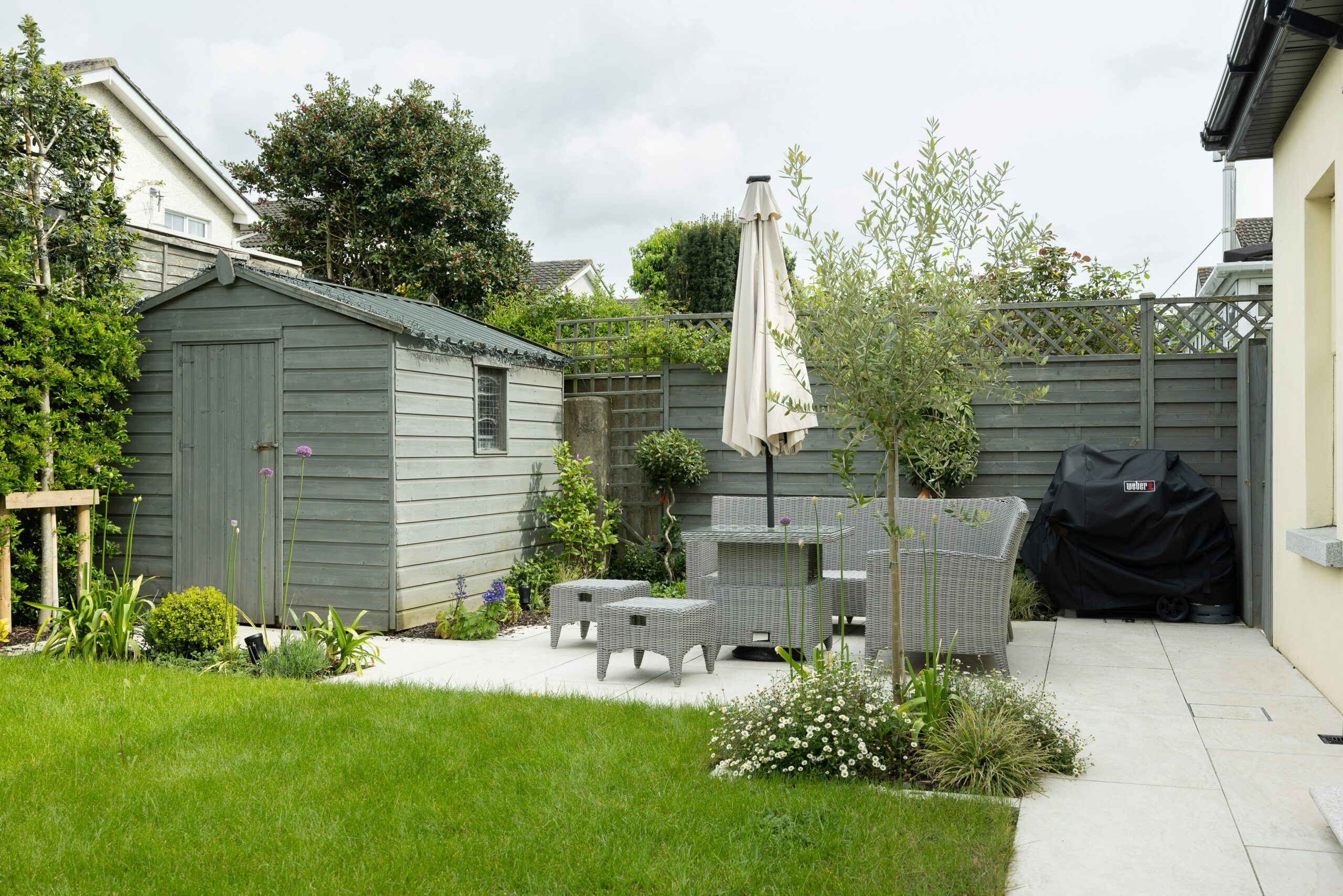
Zone A (The Main Stage): This is usually the wider part directly behind the house. Keep this for high-traffic stuff.
- Dining tables.
- Grilling stations.
- The primary deck or patio.
Zone B (The Retreat): The narrower “leg” of the L is usually more private.
- A reading nook.
- A vegetable garden.
- A kids’ play area (hidden from the main view).
The Connection: You need a visual thread. Don’t just let grass run wild.
- Use a consistent material (such as stepping stones) that connects Zone A with Zone B.
- Maintain the same fence style in both zones to deceive the eye into seeing unity.
Pro Tip: If you can’t see Zone B from the rear door, it’s a win. It conveys a sense of “destination.” Make them walk around the corner to discover the surprise.
Fix #2: Conquering the “Dead Corner”
Do you know that difficult place where the two legs of the L meet? That’s the “hinge.” If this part is lifeless, the entire yard appears disconnected.
Soften the Angle: L-yards are full of harsh lines. Don’t add more squares.
- Use a curved garden bed right at the inner corner.
- Plant ornamental grasses that sway; they break up the rigid 90-degree feel.
The Focal Point Trick: Put something tall or eye-catching right in that transition zone.
- A bubbling water feature.
- A fire pit (circular shapes work best here).
- A small pergola.
Why this works: It directs the eye to the bend rather than keeping it fixed on the fence line. It beckons you to turn the corner.
According to Better Homes & Gardens’ landscape design guidelines, softening rough corners is the most effective approach to make a small room appear larger.
Fix #3: Vertical Layering for Privacy
L-shaped yards frequently wrap around a neighbor’s property, resulting in more shared fence lines than a typical yard. You’re basically on display.
Don’t build a wall: A solid 8-foot fence makes it feel like a prison cell.
Layer your screening:
- Back Layer: The existing fence.
- Middle Layer: Tall, narrow trees like Sky Pencil Holly or Bamboo (in containers, please, unless you want a jungle takeover).
- Front Layer: Lower shrubs or seating.
The “Green Wall” Effect:
- Install a trellis on the narrowest leg of the L.
- Grow Jasmine or Clematis.
- This draws the eye up and distracts from the narrow width of the yard.
Fix #4: Patio Placement Mistakes
I see that all the time. People pour a concrete slab directly in the center of the “L” junction. It causes a traffic bottleneck.
The Traffic Flow Rule: The junction needs to be a walkway, not a sitting area.
Push the Patio Back:
- Place the main seating area deep into the wider part of the yard.
- This keeps the flow open.
The “Satellite” Patio:
- Put a tiny bistro table or a bench at the very end of the narrow leg.
- It gives you a reason to walk to the end of the property.
- If there is nothing at the end, nobody goes there. Simple as that.
Fix #5: Lighting the “Blind Spots”
One floodlight may suffice to illuminate a rectangular yard. What about in an L-shaped yard? Forget it. You’ve got shadows everywhere.
Path Lighting is Mandatory:
- You need to light the path around the corner.
- Solar stakes are cheap and effective.
Uplighting Trees:
- Put a spotlight at the base of a tree in the far “hidden” corner.
- When you look out the window at night, you see depth.
- Without this, the yard looks half the size at night because the leg disappears into darkness.
String Lights:
- Zig-zag them across the narrow leg.
- It lowers the “ceiling” of the outdoor room, making it feel cozy instead of claustrophobic.
Check out some lighting guides on The Spruce for safe low-voltage installation tips.
Fix #6: Furniture Arrangement (Don’t Line the Walls)
Stop putting all of your furniture against the fence. It looks like a middle-school dance.
Float the Furniture:
- Pull the seating group into the middle of the wider zone.
- Leave a path behind the chairs.
- This creates volume.
Round Tables vs. Square Tables:
- Go round.
- Round tables break the “box” effect of the L-shape.
- They are easier to walk around in tight spaces.
Fix #7: The “False Perspective” Trick
This is a small visual cheat code employed by professionals.
Narrow Leg Strategy:
- If the narrow leg of the L looks too tight, plant larger leaf plants (like Hostas or Ferns) near the entrance of that zone.
- Plant finer-texture plants (like small grasses) at the far end.
- Why? It forces a perspective shift that makes the space look longer than it is.
The Mirror Trick:
- Hang a weatherproof mirror on the back fence of the narrow leg.
- It reflects the greenery and makes the tunnel feel like it continues forever.
Common Mistakes to Avoid
- Overpaving: Don’t pave the entire L. To absorb noise and heat, you will require softscape (plants).
- Blocking the View: Avoid planting a large bush right in the inner corner. You want to see the yard continue, not hide it.
- Ignoring Drainage: L-shaped yards frequently retain water in the corners. Make sure you slope the dirt away from the home foundation.
Final Thoughts
Fixing an L-shaped yard does not imply battling the shape. It is about leaning into it. You have the privacy and mystery that a rectangular yard will never provide.
What’s the key takeaway? Embrace the zones. Let the corner be a transition, not a barrier. And, for the love of gardening, keep the hinge point free of junk.
Try to move your stuff this weekend. Try out the “floating” setup. You might discover you have a lot more space than you imagined.
FAQs
How can I make my L-shaped yard look larger?
Blur the lines. To visibly retreat fences, use a dark color (black or charcoal). Use the zoning strategy to generate several destinations rather than a single constrained area.
What is the ideal arrangement for a narrow L-shaped garden?
Use the “diagonal” layout. Orient your pavers or decking boards at a 45-degree angle. It tricks the brain into perceiving space as larger.
Where should I place the shed in an L-shaped yard?
Never stay in the inner corner. Place it at the end of the narrowest leg, or along the side of the house in the “dead space” where nothing grows.