
If you’ve ever seen a perfectly healthy cabbage seedling perish overnight under a swarm of aphids, you’ll understand that a garden is not a quiet refuge, but rather an active conflict.
For years, my approach to the war was reactionary. I’d see a bug, panic, and reach for the spray. My harvests improved only after I began to think of my garden as an ecosystem rather than a collection of individual plants.
Companion planting is frequently portrayed in gardening folklore as plants just “liking” each other. The reality is far more scientific and mechanical. Plants cannot move, thus they must change their surroundings to live. They accomplish this by altering soil biochemistry, emitting chemical signals, influencing microclimates, and supporting beneficial insect populations.
When done effectively, companion planting minimises pest strain, optimises space, and enhances soil health. When done incorrectly, you wind up with a tangled, congested mess fighting for water and light.
The Science of Plant Partnerships: Why It Actually Works?
To move beyond the myths, we have to look at the specific mechanisms of how plants interact. If you understand the why, you can start designing your own layouts without relying on a rigid chart.
1. Odor Masking and Chemical Disruption
Many insects locate their host plants through complex olfactory cues. When you plant a massive row of nothing but carrots, you are sending a clear, uninterrupted scent signal to the carrot rust fly.
By interplanting highly aromatic plants, you disrupt these signals. For example, planting onions or chives near carrots significantly reduces carrot fly attacks by masking the carrots’ scent.
Similarly, thyme and sage can disrupt the egg-laying behavior of the diamondback moth, a notorious pest of brassicas like broccoli and cabbage.
2. Trap Cropping (The Decoy Strategy)
Instead of trying to push pests away, trap cropping actively lures them to a highly desirable sacrificial plant. This is a powerful [integrated pest management (IPM) strategy] utilized heavily in organic farming.
- Cucumber Beetles: Research funded by Southern SARE has shown that planting Blue Hubbard squash near zucchini or yellow squash acts as an incredibly effective trap crop. The beetles vastly prefer the Blue Hubbard, swarming it and leaving your primary harvest alone.
- Harlequin Bugs: A border of mustard greens (specifically ‘Southern Giant Curled’) will pull harlequin bugs away from your prized collards and kale, keeping feeding damage on the cash crop below 25 percent.
The Trade-off: Trap crops require active management. If you do not kill the pests congregating on the trap crop (either manually, with insecticidal soap, or by destroying the infested plant), you simply create a massive breeding ground that will eventually spill over into your main crop.
3. Spatial and Microclimate Manipulation
You can manipulate the physical space above and below the soil to your advantage. A classic example is the “subterranean method.” When you bury seed potatoes deep in a trench, it takes weeks for the foliage to break the surface.
In the meantime, you can sow a fast-growing, shallow-rooted crop like radishes or lettuce directly on top. By the time the potatoes need the light and space, the radishes are already harvested.
Above ground, you can use heat-tolerant plants to cast a beneficial shadow. Peppers thrive in the heat, but when temperatures climb past 90°F, they can drop blossoms and suffer. Planting a larger, bushy eggplant at an angle to block the harshest afternoon sun can provide just enough natural shade to keep the peppers producing.
Real-World Case Study
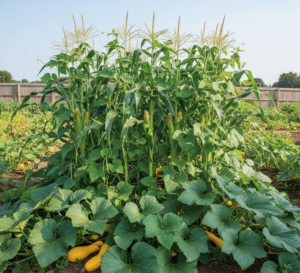
The most famous companion planting guild is the “Three Sisters,” a centuries-old agricultural model developed by Native American tribes. It combines corn, pole beans, and squash.
The mechanics are brilliant: the corn provides a sturdy living trellis for the beans. The beans, as legumes, fix atmospheric nitrogen into the soil. The squash vines sprawl across the ground, acting as a living mulch that shades out weed competition and retains soil moisture.
However, many gardeners fail at this layout because they plant all the seeds on the same day. If you do this, the rapidly growing beans will drag down the fragile young corn stalks, and the giant squash leaves will smother everything.
The Implementation Timeline:
- Sow the Corn: Plant corn seeds first, in staggered rows or blocks about 8 inches apart to ensure good wind pollination.
- Wait for Height: Wait two to three weeks until the corn is 4 to 6 inches tall and established.
- Sow the Beans: Plant pole beans (not bush beans) about 6 inches away from the base of the corn stalks. Before planting, it is highly recommended to inoculate the bean seeds with rhizobia bacteria to maximize their nitrogen-fixing capabilities.
- Sow the Squash: Two weeks after the beans germinate, plant squash seeds along the outer perimeter of the bed, spacing them every 2 feet. This delay prevents the squash from out-competing the corn and beans for early sunlight.
The Trade-off: Navigating a mature Three Sisters garden is difficult. Wading through prickly squash vines to hunt for fresh green beans is a scratched-up nightmare.
This system was originally designed for storage crops,, dent corn, dry beans, and winter squash,, where the entire bed is left alone to mature and harvested all at once at the end of the season. If you want fresh snap beans and sweet corn, plant them on the edges for easier access.
Practical Layout Examples for the Home Garden
To help you move from theory to practice, here are a few practical, proven layout combinations that utilize different root depths, growth habits, and pest-deterrent properties.
| Primary Crop | Companion Plants | Layout & Spacing | Expected Benefit |
|---|---|---|---|
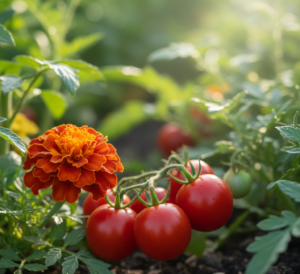
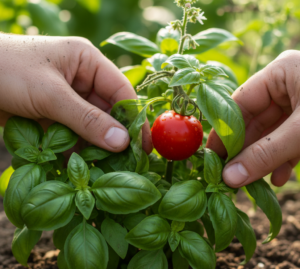
| Tomatoes | Basil & French Marigolds | Plant 1 basil plant and 1 marigold 12 inches from the base of each tomato plant. | Basil masks the tomato scent from hornworm moths. French marigolds release root exudates that actively suppress root-knot nematodes in the soil. |
| Cabbage | Dill & Onions | Plant cabbage on 18-inch centers. Interplant dill every 3 feet. Line the bed border with bunching onions. | The onions mask the scent of the brassicas from cabbage moths. The dill attracts tiny parasitoid wasps that lay eggs inside cabbage worms, naturally controlling the population. |
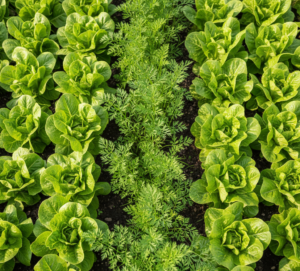
| Carrots | Radishes & Lettuce | Sow a row of carrots mixed with radish seed. Plant leaf lettuce tightly between the rows. | Radishes germinate in 4 days, breaking the soil crust for the slower carrots. The lettuce has shallow roots that don’t compete with the deep taproots of the carrots, and the carrot fronds shade the lettuce in the summer heat. |
| Potatoes | Bush Beans | Alternate rows: one row of potatoes, one row of bush beans (spaced 12 inches apart). | A fascinating mutual benefit: the beans deter the Colorado potato beetle, while the potatoes repel the Mexican bean beetle. |
The Dark Side: Incompatible Plants
Not all plants are good neighbors. Putting the wrong crops together can devastate your yield through resource competition, shared pathogens, or a chemical warfare mechanism known as allelopathy.
- Allelopathy: Some plants actively secrete toxins into the soil to kill off competition. The most famous is the Black Walnut tree, which releases juglone, a chemical highly toxic to tomatoes, peppers, and potatoes. Sunflowers also release allelopathic chemicals (allelopathins) that can severely stunt the growth of nearby pole beans and potatoes.
- Shared Pathogens: Never plant potatoes and tomatoes next to each other. Because they are both in the nightshade family, they are highly susceptible to the same soil-borne diseases, particularly early and late blight. If one catches it, the infection will rapidly sweep through both crops.
- Fennel the Loner: Fennel is notorious in the garden. It produces strong allelopathic chemicals that inhibit the growth of almost everything around it, particularly bush beans, tomatoes, and kohlrabi. Fennel should always be planted in its own isolated container or dedicated bed.
Step-by-Step Guide to Designing a Companion Bed
If you want to design your garden layouts for maximum ecological benefit, do not just throw seeds in the ground and hope for the best. Follow this sequence:
- Anchor with the Heavy Feeders: Decide on your primary, long-season crop first (e.g., Tomatoes, Cabbage, or Peppers). Place them in the bed according to their mature spacing requirements.
- Add the Pest Confusers: Choose strongly scented herbs (onions, garlic, basil, sage) and interplant them between the main crops to disrupt insect olfactory cues.
- Integrate the Pollinator Magnets: Select composite flowers (zinnias, cosmos, calendula) and plant them along the borders of the bed. These provide shallow nectar cups that attract beneficial hoverflies and parasitoid wasps.
- Fill the Bare Soil: Nature hates bare dirt. Utilize the understory by planting fast-growing, shade-tolerant greens (spinach, arugula) or radishes to act as a living mulch.
Common Mistakes to Avoid
- The Emergency Planting Fallacy: Companion planting is a preventative measure, not a cure. Planting marigolds beside a tomato plant that is already covered in whiteflies will not save it. Companion plants must be established before the pest pressure arrives.
- Overcrowding for the Sake of Companions: It is easy to get carried away packing beneficial plants together. However, if you plant basil so close to your tomatoes that airflow is restricted, you are creating a humid microclimate perfect for fungal diseases. Always respect the mature footprint of the plant.
- Ignoring the Soil: No amount of clever companion planting will save a garden with dead, compacted soil. Correct spacing, proper watering, and [building healthy organic soil] remain the most important influences on your garden’s success.
Summary
Companion planting is an applied science that leverages the natural behaviors of plants and insects. By utilizing trap crops to draw pests away, masking odors with heavy-scented alliums and herbs, and stacking plants by root depth and light requirements, you can build a self-sustaining garden ecosystem.
It requires more upfront planning and a willingness to tolerate some level of insect life in the garden. Still, the trade-off is a massive reduction in chemical interventions, healthier soil, and significantly higher yields per square foot.
Frequently Asked Questions
Do marigolds actually repel pests?
Yes, but with caveats. French marigolds secrete a compound from their roots that suppresses root-knot nematodes in the soil. Above ground, their scent can help deter some beetles and moths, but they also act as a trap crop for spider mites. They are a great addition, but they are not a magical shield.
Can I companion plant in raised beds or containers?
In fact, companion planting is incredibly effective in raised beds because the loose soil allows for denser planting. You need to pay closer attention to water and nutrient competition. In a 15-gallon container, pairing one pepper plant with a low-growing border of chives or trailing alyssum works perfectly.
How close do plants need to be actually to benefit each other?
For root-based benefits (like nitrogen fixing from beans or nematode suppression from marigolds), the root zones must physically overlap in the soil. For pest deterrence (like basil masking tomatoes), the plants should be within 1 to 2 feet of each other so the volatile oils intermingle in the air canopy.
Does companion planting replace the need for pesticides?
Not entirely. It is a foundational piece of Integrated Pest Management (IPM). It heavily reduces the need for interventions, but in years with extreme weather or localized pest outbreaks, you may still need to remove pests or utilize organic treatments manually. The goal is balance, not total eradication.