

Most of us have bought a lovely, costly notebook, brought it home, and then left it sitting on a desk for months, empty. The concern of destroying the perfect first page with sloppy handwriting or banal ideas is a common impediment for rookie journalers.
We frequently think of journaling as a performance or a rigorous historical record, rather than a very customisable instrument for mental clarity and self-expression. Starting a journaling habit necessitates renouncing the notion of perfection.
Whether you want to organise your hectic schedule, process complex emotions, or document your life, a notebook is designed to help you, not stress you out.
If you want to develop a long-term journaling habit that lasts beyond the initial surge of motivation, you must first understand the mechanics of the practice, then select the appropriate medium and apply a structure that works for your everyday life.
Choosing Your Arena: Analog vs. Digital Trade-offs
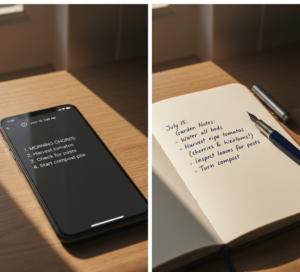
The first step in beginning a journaling pastime is determining where to write. Both physical paper and digital applications provide significant, albeit distinct, advantages. Your choice should be based on what you value more: sensory engagement and cognitive depth, or convenience, speed, and long-term structure.
The Case for Digital Journaling
Digital journaling solutions such as Day One and Notion are designed for speed and usability. The average individual types at about 40 words per minute (WPM), which allows you to brain dump ideas considerably faster than you can write them.
Digital tools also excel in media integration and organization. You may include daily images, audio recordings, and utilise full-text search to follow individual entries or emotional patterns over time. However, this convenience has unique drawbacks.
The main trade-off is distraction. With 70% of people reporting routine notification interruptions and an average recovery period of more than 23 minutes, it can be extremely difficult to maintain deep concentration on a screen.
Reliance on proprietary apps increases the risk of “lock-in” or data loss if the company fails, as witnessed with platforms like Penzu.
The Case for Traditional Paper Journaling
Handwriting is undeniably slower, averaging just 13 WPM. Yet, this forced deceleration is exactly why paper journaling is so effective. Writing by hand activates complex neural pathways that significantly boost memory retention and emotional processing.
Research from Princeton and the University of California demonstrated that individuals who process information by hand exhibit a 25% better understanding of conceptual ideas than those who type.
A physical notebook also offers a screen-free sanctuary. Studies indicate that using electronic devices before bed delays sleep onset by an average of 30 minutes. Spending 15 minutes writing in a paper journal before sleep promotes mindfulness without the blue-light disruption.
The physical limitation, however, is storage; writing daily can fill up to 4 notebooks a year, which requires physical space and manual indexing to navigate past entries.
Quick Comparison Table
| Feature | Digital Journaling | Traditional Paper Journaling |
|---|---|---|
| Input Speed | Fast (averages 40 WPM) | Slower (averages 13 WPM) |
| Cognitive Impact | Prone to multitasking & distraction | High engagement improves memory retention |
| Organization | Instant search, tags, and automatic backups | Manual indexing, chronologically locked, |
| Media | Supports photos, audio, and location data | Text, sketches, and physical ephemera |
| Average Cost | ~$35/year for premium software subscriptions | Variable cost of notebooks and pens |
If you are a beginner, consider what friction point is most likely to stop you. If you hate hand cramps and want your journal with you at all times, go digital. If you stare at screens all day and crave tactile, quiet reflection, buy a physical notebook.
Finding a Journaling Style That Fits Your Brain
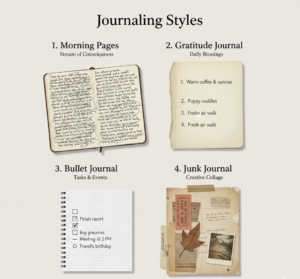
“Dear Diary” is not the only way to document your life. If unstructured freewriting feels intimidating, adopting a specific framework can provide the scaffolding you need to start.
The Cognitive Drain: Morning Pages
Created by author Julia Cameron, Morning Pages consist of three handwritten pages (roughly 750 words) of stream-of-consciousness writing, done immediately upon waking.
The goal is to catch your brain before your ego or the “Censor” wakes up and establishes its daily defenses. You write whatever comes to mind without editing, even if it is simply, “I don’t know what to write.”
Why it works: The science backing this method is tied to cognitive load theory. Dr. James Pennebaker’s extensive research on expressive writing at the University of Texas reveals that suppressing thoughts drains mental energy. Externalizing anxieties on paper frees up working memory, effectively “taking out the mental trash” so you can focus on the day ahead.
The Positivity Anchor: Gratitude Journaling
Gratitude journaling focuses exclusively on recording things you are thankful for. Psychological studies by Emmons and McCullough demonstrate that keeping a gratitude log leads to heightened optimism, better sleep quality, and fewer physical symptoms of illness.
Implementation detail: Aim for 3 to 10 specific items per entry. Surprisingly, research indicates that writing in a gratitude journal just once a week often yields better long-term happiness results than daily writing, as daily repetition can cause the practice to lose its novelty and feel like a chore.
The Artistic Outlet: Junk Journaling
If you are intimidated by writing, junk journaling might be your ideal entry point. A junk journal is a handmade book constructed from recycled or upcycled materials, such as letters, vintage book pages, product packaging, and even junk mail.
Unlike traditional scrapbooking, which is highly structured around specific memories or pristine photos, junk journaling is entirely rule-free and relies heavily on found items. It is a tactile, highly therapeutic papercraft hobby that allows you to layer ephemera, practice basic collage techniques, and express yourself visually rather than verbally.
The Action-Oriented Method: Bullet Journaling
For those who want to merge productivity with reflection, bullet journaling acts as a planner, to-do list, and diary combined. It utilizes rapid logging—a system of bullets, dashes, and specific symbols to categorize tasks, events, and brief emotional notes efficiently.
This is ideal for individuals who want to track their lives without spending 45 minutes writing long-form paragraphs.
Real-World Case Study
The Scenario: Mark, a project manager, started a traditional journal to manage workplace stress. Every evening, he opened his notebook and wrote detailed accounts of his frustrations: missed deadlines, demanding clients, and his own exhaustion.
The Problem: Within a month, Mark stopped journaling. He realized he dreaded opening his notebook because it had become a concentrated archive of his worst moments. By only recording negatives, he was unintentionally reinforcing his stress, training his brain to view the journal as a place of judgment and anger.
The Fix: Mark shifted his approach by implementing Balanced Entries. He still allowed himself to vent, but he instituted a hard rule: for every paragraph of frustration, he had to write two sentences about something he handled well, or a moment of relief he experienced that day. Balancing the emotional weight of a journal ensures it remains a tool for processing life, rather than merely a catalog of misery.
Overcoming the Blank Page (Practical Prompts)

Sometimes, your day consists of going to the grocery store, answering emails, and watching television. When you feel like you have nothing to report, rely on targeted prompts to spark self-discovery.
If you are staring at a blank page, try answering one of these questions:
- “When I am in pain—physical or emotional—the kindest thing I can do for myself is…”
- “What is one topic I need to learn more about to help me live a more fulfilling life?”
- “If I could talk to my teenage self, the one thing I would say is…”
Alternatively, try writing a letter to yourself, or to a pretend pen pal. Removing the pressure of “recording history” and framing the entry as a simple correspondence can lower the barrier to entry.
A Note on Privacy Constraints
It is impossible to write honestly if you are terrified someone will read your journal. If you live with nosy family members or roommates, this anxiety will cause you to subconsciously self-censor.
To bypass this, consider writing in an encrypted, password-protected digital app. If you prefer paper, you can use a basic cipher or an alternate alphabet. Ultimately, remember that the value of journaling lies in the act of writing itself, not in the preservation of the book.
It is highly therapeutic to write out complex, vulnerable thoughts, and immediately tear the page out and throw it away.
Why Beginners Fail (And How to Fix It)?
Even with the best intentions, new journalers frequently stumble into invisible psychological traps. Recognizing these early will save your habit.
- Expecting Aesthetic Perfection: Social media is flooded with perfectly calligraphed, beautifully illustrated journal pages. Trying to emulate this turns journaling into a performance. You start editing your raw thoughts to make the sentence “sound better”. Fix: Deliberately make your journal messy. Cross things out. Spell words wrong. A journal is a mental workbench, not a museum display.
- The Inconsistency Guilt-Trip: You write every day for a week, then miss three days. When you finally return to the book, you feel obligated to write a massive summary to “catch up” on what you missed. Fix: Let the gap exist. Never apologize to your journal. Write today’s date and move forward.
- Writing Without a Core Purpose: Recording your daily lunch and the weather gets boring quickly. When entries remain purely surface-level, journaling feels like busywork. Fix: Ask yourself why an event mattered. Don’t just record that a meeting was canceled; explore how the sudden free time made you feel.
Step-by-Step Implementation Checklist
To build a routine that actually sticks, follow this practical setup checklist:
- Choose your medium decisively: Select one app or buy one notebook. Do not split your entries across multiple platforms while you are building the habit.
- Attach the habit to an existing trigger: Do not rely on finding “free time.” Link your journaling to an unbreakable daily routine, such as drinking your morning coffee, or right after brushing your teeth at night.
- Set a micro-quota: Tell yourself you only have to write for two minutes, or fill half a page. A low barrier to entry ensures you will do it even when you are exhausted.
- Define your privacy protocol: Decide beforehand where the journal will be stored to ensure you feel safe enough to write honestly.
Final Thoughts
Starting a journaling pastime is an investment in your personal self-awareness. It offers a rare, calm area in an overly noisy society to analyse your life without external influence or judgement.
Whether you wind up scribbling jumbled paragraphs over morning coffee, posting digital entries on your commute, or gluing old tickets into a junk journal, the most crucial step is simply putting pen to paper and allowing yourself to be completely, unabashedly human.