
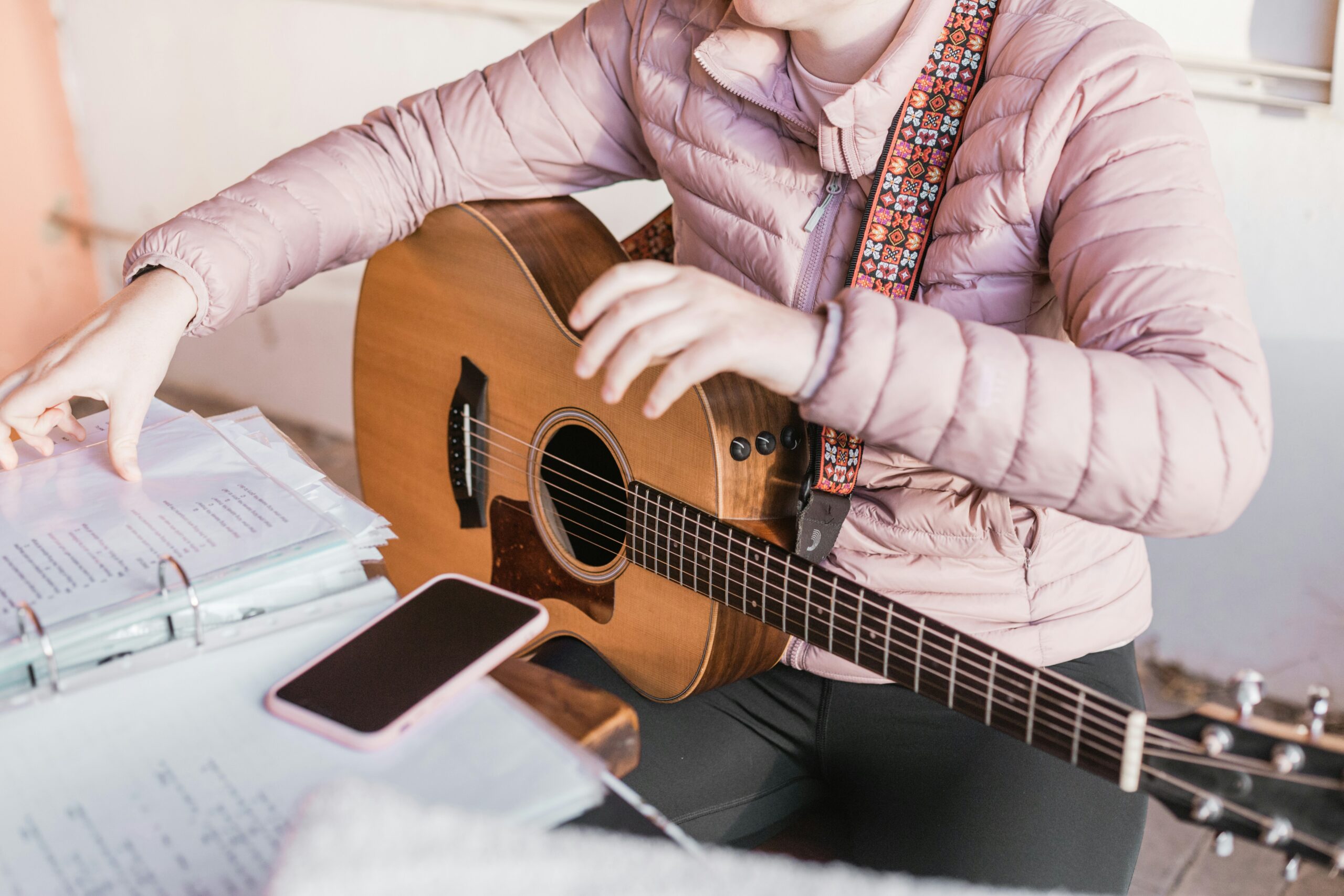
There is a constant and discouraging myth that kids are the only ones who can learn to play music well. In truth, things are very different. Kids do better when they have a lot of unstructured free time, but adults bring control, the ability to think critically, and emotional depth to the practice room.
The hardest thing about teaching music to adults isn’t usually that they can’t change their minds; it’s when the demands of a new instrument clash with the strict rules of adult life.
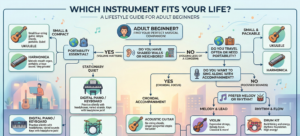
When picking out an instrument, it’s not just about what you want to hear; it’s also about what your daily life, living space, and body can handle.
The Cognitive Reality of the Adult Beginner
You should know about the neurological machinery you are working with before you look at specific tools. Neuroplasticity is the process by which the brain changes. Learning a difficult, multisensory job like playing an instrument speeds up neuroplasticity.
Regular musical practice changes the shape of the brain by adding more grey matter to areas that control behavior, remember things, and move the body.
The white matter of the brain gets stronger through training, especially the arcuate fasciculus, which is a crucial nerve route that links areas that process sound with regions that control movement. General intelligence, in fact, explains more than 20% of the differences in how quickly people learn how to use a keyboard for the first time.
Your real-life knowledge, ability to handle stress, and ability to solve problems are huge strengths. The only thing that matters is that you choose an instrument that doesn’t automatically clash with your lifestyle.
The Spatial Constraint: Acoustics and Shared Walls
If you live in a dense urban environment or share walls with noise-sensitive neighbors, sheer volume is the enemy of consistent practice. Acoustic drums or a brass section will rapidly result in noise complaints.
To maintain a sustainable practice habit, you must look toward inherently quiet instruments or modern silent technology.
Naturally Low-Volume Options
For adults seeking acoustic authenticity without the volume, the kalimba (or thumb piano) is an exceptional choice. The instrument directs its bright, melodic tones primarily toward the player, filling a small room but fading quickly beyond those walls.
Similarly, the jaw harp utilizes the player’s own mouth cavity as a natural resonance chamber, creating sharp percussive sounds that feel loud internally but remain virtually inaudible to a roommate next door.
These instruments typically peak at moderate, non-intrusive loudness levels, allowing for late-night musical exploration without anxiety.
The “Silent” Revolution
If your heart is set on traditional orchestral or band instruments, modern acoustic-electronic hybrid designs have solved the volume problem. Yamaha’s SILENT™ series, for example, allows players to bypass the resonant acoustic properties of the instrument entirely.
- Pianos: A silent acoustic piano functions with traditional weighted keys, strings, and hammers. However, when switched to silent mode, the hammers are physically barred from striking the strings; instead, optical sensors beneath the keys measure the nuance of the keystroke and trigger a high-fidelity digital sample via headphones.
- Guitars: Silent guitars feature a skeletal frame without a resonant wooden body, relying on digital modeling pickups to emulate the sound of a studio-mic’d acoustic guitar through your headset.
- Brass: If you favor the trumpet or trombone, digital mute systems simulate the acoustic tone inside an electronic “personal studio” module, effectively reducing the room volume to a whisper.
The Analytical Divide: Piano vs. Guitar
When adults decide to learn music, the vast majority gravitate toward the piano or the guitar. Both are highly versatile polyphonic instruments capable of solo accompaniment, but they possess opposite learning curves and theoretical frameworks.
The Learning Curve Trade-Off
The piano offers immediate gratification; press a key, and it yields a perfect, in-tune note. After the first lesson, an adult can easily play a simple melody.
The frustration arrives a few months later when the brain must bifurcate its attention, coordinating the left and right hands in completely independent rhythmic and melodic patterns, a sensation much like patting your head while rubbing your stomach.
Conversely, the guitar is physically hostile to beginners. The wrists must hold an unnatural angle, and pressing steel strings to the fretboard will cause literal pain until calluses form over the first two weeks.
However, once you survive this initial physical barrier, the guitar becomes remarkably forgiving. Within three months, mastery of just a handful of basic chord shapes will allow you to confidently strum hundreds of popular rock, pop, and folk songs.
Linear vs. Non-Linear Theory
Your learning style should dictate your choice. The piano is a strictly linear instrument: there is only one specific key for middle-C, and as pitch increases, your hands move uniformly to the right. This makes visualizing music theory, chord relationships, and intervals highly logical.
The guitar is a non-linear matrix. Because strings overlap in pitch, there are roughly half a dozen different places on the fretboard to play the same middle-C.
While this makes melodic sight-reading more complex, it makes harmonic transposition incredibly easy; once you learn a chord “shape,” you can slide that same physical hand position up and down the neck to play in any key without learning new fingering.
| Feature | Piano / Keyboard | Acoustic Guitar |
|---|---|---|
| Initial Physical Comfort | High (Visual layout, easy to press keys) | Low (Fingertip pain, awkward wrist angle) |
| 3-Month Milestone | Basic two-hand coordination | Confident chord strumming for popular songs |
| Theory Layout | Linear (One key per pitch) | Non-linear (Multiple locations for one pitch) |
| Portability | Low (Requires power source or heavy lifting) | High (Can travel anywhere easily) |
| Vocal Pairing | Best with bright, virtuosic, clear voices | Best with folksy, darker, airy voices |
Aligning Instrument with Physiology
Adults must be pragmatic about their physical limitations. Heavy instruments, like the double bass, require significant physical strength and stamina to haul and play. Wind instruments, such as the flute or saxophone, demand strong lung capacity and diaphragmatic breath control.
If you suffer from joint sensitivity or limited hand strength, the acoustic guitar may be discouraging. In this scenario, the ukulele is a brilliant alternative. It is highly compact, features only four relatively soft nylon strings, and allows beginners to form complex-sounding chords with just one or two fingers.
Time Architecture: The “5-9” Routine
The most significant barrier for the adult learner is time. You are likely balancing a 9-to-5 job, a commute, and domestic responsibilities. The mistake most adults make is assuming musical progress requires hour-long blocks of unbroken free time.
Neurologically, motor learning thrives on frequency, not duration. Binge-practicing for two hours on a Sunday is far less effective than practicing for 20 deliberate minutes daily. Your brain consolidates motor memory during sleep, meaning daily touchpoints with the instrument yield faster neurological adaptation.
- Audit Your Schedule: Look at your “5-9” routine (the hours after work). Identify a consistent 15–30 minute pocket.
- Remove Friction: If your guitar is locked in its case in the closet, you will not play it. Leave it on a stand in your living room. If you play the keyboard, leave it plugged in with the headphones resting on the keys.
- Targeted Goals: Dedicate specific micro-sessions to single tasks. Spend 10 minutes on a particular rudiment of finger, and 10 minutes playing purely for enjoyment.
Real-World Case Example
Consider the real-world scenario of James, a 51-year-old professional who decided to fulfill a lifelong desire to play the drums. An acoustic drum kit in his suburban neighborhood would have been a logistical nightmare regarding noise. Furthermore, learning four-limb independence in your fifties can feel neurologically overwhelming.
James navigated the noise constraint by purchasing an electronic drum kit featuring multi-zone mesh pads, allowing him to practice silently using headphones while retaining the physical rebound of real drum heads.
To tackle the cognitive overload, he utilized the electronic module’s built-in metronome and training tracks, isolating his footwork from his handwork during short 20-minute daily sessions before dinner.
He noted that engaging with a community of adult learners kept him motivated through the inevitable plateaus, proving that the struggle of regaining physical coordination is universal, not a sign of being “too old”.
Common Mistakes for Adult Beginners
- Chasing “Childhood” Repertoire: Adults learn best when the material feels relevant and emotionally engaging. Skip “Mary Had a Little Lamb.” Find simplified chord charts of songs you genuinely love.
- Ignoring Ergonomics: Poor posture at a piano or slumping over a guitar will lead to back pain and tendon strain. Invest in a proper bench, a footstool, or a music stand.
- The “All or Nothing” Mindset: Life interrupts practice routines. If you miss three days, do not abandon the week. A 5-minute session of running through a single scale is infinitely better than zero minutes.
- Isolating the Practice: Music is a language meant to be shared. Even as a beginner, finding a low-pressure group class or an online forum can alleviate the isolation of the practice room.
The Last Word
As an adult, learning an instrument is not a race to the music hall stage; it is a way to take back control of your life. It’s about making time in the middle of a busy life for personal growth, mental health, and feeling what you’re feeling.
The best instrument is the one that fits easily into your life. This is true whether you want the quiet intimacy of a kalimba in a high-rise apartment, the mathematical layout of a digital piano, or the rhythmic physical release of an electronic drum kit.
Questions People Ask Often
Am I too old to learn how to use my muscles properly?
Not at all. Kids naturally pick up physical skills quickly, but adults can make up for it by practicing with purpose and focus. Adults can effectively build muscle memory with short, focused exercises, and consistency is much more important than starting age.
Is it essential to learn how to read sheet music?
It all depends on the instrument and what you want to achieve. Sight-reading is very important for classical piano or violin. If you want to play pop songs on the guitar or ukulele, on the other hand, learning chord charts, tablature, and playing by ear is the usual way to do it and works very well.
Is it worth it to buy a cheap instrument to try out first?
Buy the best instrument that your budget will allow. Very cheap, poorly made instruments, which are often called “guitar-shaped objects” in the business, are complex to keep in tune and play. This makes you feel even more frustrated, which makes you more likely to give up.