

We’ve all been there: staring at a $250 set of perfect watercolor paints, a high-end mechanical keyboard, or a garage full of rock-climbing gear that hasn’t been used since the week it arrived.
The desire to pursue a new interest frequently begins with a burst of inspiration, only to fade when the reality of the activity does not fit into our daily lives or natural temperaments.
Choosing a hobby should not be a random guess. It is a calculated balance of your psychological demands, cognitive resources, and lifestyle limits.
When chosen right, a pastime serves as a protective structure for your mental health, fostering resilience and self-efficacy that spills over into your professional and personal life.
When chosen incorrectly, it becomes just another obligation a source of shame collecting dust in the corner of a room.
The Hidden Math of Work-Leisure Similarity
We have to address the most common mistake people make when choosing a leisure activity: selecting a hobby that taxes the same cognitive or physical resources as their day job.
According to the Conservation of Resources (COR) theory, humans are driven to acquire and protect psychological and physical resources.
When you work a demanding job, you deplete specific reserves. If your hobby draws from those identical reserves, you aren’t recharging; you are accelerating burnout.
A fascinating dynamic occurs at the intersection of how “serious” you are about a hobby and how similar it is to your work.
A 2020 study published in the Journal of Vocational Behavior tracked the effects of leisure time on career sustainability and found a clear pattern. If you engage in “serious leisure”—hobbies requiring deep commitment, skill acquisition, and perseverance, and that hobby demands the same skills as your job, your overall self-efficacy and resilience actually drop.
The Trade-Off: If you are a software developer who spends 40 hours a week solving complex logic problems on a screen, taking up competitive, strategy-heavy video gaming as a serious hobby will likely deplete your remaining cognitive resources.
You need an activity with low work-leisure similarity something tactile, physical, or socially fluid, like community theater, bouldering, or cooking.
Building Your “Protective Architecture”
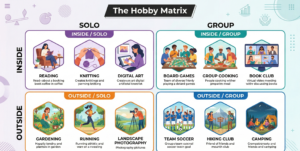
A highly effective way to audit your current lifestyle and identify what type of hobby you actually need is to use the Hobby Matrix. Developed in clinical treatment settings to help individuals build resilient routines, the matrix divides activities into four distinct quadrants based on two axes: Inside vs. Outside, and Solo vs. Group.
Balance does not mean you must spend exactly 25% of your time in each quadrant. Rather, the goal is to ensure no single quadrant is chronically empty. A life heavily clustered in only one or two environments is highly vulnerable to disruption.
Real-World Case Study: The Matrix in Action
Consider the case of a 33-year-old professional navigating a difficult breakup during the winter months.
A lifestyle audit revealed dangerous clustering:
- Inside / Solo: Dominant. She spent most evenings online shopping (a coping mechanism causing financial stress) and watching television.
- Inside / Group: Empty. She had alienated friends during the relationship.
- Outside / Solo: Empty.
- Outside / Group: Empty.
The Implementation Strategy: Because her current routine was heavily clustered in the Inside/Solo quadrant, suggesting an Outside/Group hobby (like a winter hiking club) would be too extreme a behavioral jump. Instead, the strategy relied on bridging.
She was guided to book a solo, highly active trip for the upcoming summer. To prepare, she began exercising a few times a week (Outside/Solo). She then reached out to a few old friends for simple dinners (Inside/Group).
By identifying the empty quadrants, she systematically introduced hobbies that rebuilt her social and physical resilience without overwhelming her schedule.
Decoding Your Personality Profile for Leisure
Your psychological makeup dictates not only what you like to do, but how you like to do it. Are you interested in the process of discovery or the satisfaction of mastery?
The Big Five: Openness to Experience
In the Five-Factor Model of personality, “Openness” heavily dictates leisure preferences. It consists of several sub-facets: Fantasy, Aesthetics, Feelings, Actions, Ideas, and Values.
- High Openness: Individuals scoring high here crave variety, abstract theories, and aesthetic beauty. They often find routine stifling. If you fit this profile, you will thrive in liberal arts pursuits (creative writing, painting, playing a musical instrument) or unstructured travel.
- Low Openness: Individuals scoring lower prefer the familiar, value concrete facts, and appreciate regimented logic. If this is you, avoid hobbies that require constant abstract interpretation. You will likely find deep satisfaction in structured activities like scale modeling, woodworking, investing, or highly categorized collecting (e.g., numismatics or vintage horology).
The Explorer vs. The Master
If we look at cognitive processing styles (such as those found in Myers-Briggs typing), we see a sharp divide in how people pursue hobbies.
Intuitive/Prospecting Types love the thrill of the new. For these individuals, exploring different hobbies is actually a hobby in itself. They are highly likely to test out lampworking, switch to rock polishing a month later, and then move on to aquascaping.
- The Trap: Feeling guilty for not finishing things. If you are naturally driven by novelty, do not choose a hobby that requires years of tedious foundational work before you see results. Embrace fluid, project-based leisure.
Observant/Judging Types prioritize stability, order, and deep mastery. They have the patience for extended concentration on repetitive tasks that others might find agonizing.
- The Trap: Spreading themselves too thin. These individuals should commit to only one or two serious hobbies—like indoor gardening, marathon training, or chess—and revel in the slow, rewarding climb to expertise.
Practical Layout: Matching Traits to Hobby Categories
| Personality Trait Dominance | Preferred Leisure Style | Optimal Hobby Examples |
|---|---|---|
| High Novelty / Abstract | Liberal Arts & Tinkering | Creative writing, resin art, tabletop role-playing games, improv comedy. |
| Highly Regimented / Logical | Collecting & Making | Restoring antique machinery, scale modeling, investing, and genealogy. |
| High Empathy / Social | Activity Participation | Community volunteering, choral singing, team sports, and cooking for groups. |
| Introverted / Tactile | Solo Outdoor / Making | Foraging, aquascaping, leatherworking, and solo hiking. |
Lifestyle Constraints and the $50 Testing Rule
Even if a hobby perfectly aligns with your personality, it will fail if it clashes with your lifestyle constraints. The three pillars of constraint are Time, Cost, and Social Energy.
The Gear Trap
A very common psychological pitfall when choosing a hobby is confusing the enjoyment of shopping for the hobby with the enjoyment of doing the hobby. You might love researching ultralight camping tents, comparing specifications, and buying the gear.
But when you are actually in the woods, freezing and sleeping on roots, you realize you hate camping. You just liked the equipment.
The Micro-Investment Strategy
To bypass the gear trap and protect your wallet, implement the $50 Testing Rule. Never invest more than $50 into a new hobby until you have successfully participated in it for 30 days.
- Want to try photography? Restrict yourself to your smartphone camera and a $15 manual photography app for a month.
- Want to learn the guitar? Rent one from a local music shop for $30 a month rather than buying a $600 Fender.
- Curious about foraging or local botany? Buy a $20 regional field guide and use free local parks.
If you realize the activity isn’t for you, you walk away with zero guilt and a minimal financial loss.
Step-by-Step Implementation Framework

If you are currently without a hobby, do not force yourself to pick something just because it looks impressive on social media. Follow this four-step framework:
Step 1: Audit your unexpressed needs.
Look at your daily life. What side of your personality is currently starving? If you wear a suit, manage corporate risk, and must remain highly conscientious all day, you might need a hobby that allows you to be messy, zany, or risk-taking. Identify the deficit.
Step 2: Target “Moderate Novelty.”
According to psychobiologists, the most rewarding hobbies live in the realm of moderate novelty. They push you just outside your comfort zone but don’t drop you into a state of total incompetence.
If you played baseball as a kid, joining a local softball league provides moderate novelty. Trying to learn elite-level ice-sculpting from scratch might provide extreme novelty, leading to rapid frustration.
Step 3: Lurk in the community.
Every niche interest has an established online community. Spend one week lurking on relevant subreddits or watching YouTube tutorials. Pay attention to how practitioners talk about their failures and the tedious parts of the craft. If the “boring” parts of the hobby still look interesting to you, proceed.
Step 4: Execute a low-stakes trial.
Find a local taster session, borrow equipment from a friend, or buy the cheapest viable starter kit. Set a calendar reminder for 30 days. During this trial, focus entirely on the process, not the final product.
Final Thoughts
We live in a culture that continually emphasizes production and optimization. As a result, we frequently feel pressured to pursue activities that serve as side hustles or make us appear more interesting to our peers.
You must completely discard that foundation. The ideal hobby is extremely personal. It is the activity that allows you to move outside of your primary identity, enjoy the pure delight of completing a task, and return to your regular life feeling rejuvenated rather than exhausted.
FAQs
Is it bad if I continue to forsake hobbies after a few weeks?
Not necessarily. If you have a very exploratory personality (like an Intuitive/Prospecting type), your “hobby” is learning the fundamentals of a new system. When you understand how something works, your brain is content. The only threat is financial. If you fall into this category, focus on project-based leisure with a clear end date rather than open-ended mastery.
How is my pastime developing into a second job?
Hobbies may rapidly turn into unpleasant commitments, particularly in the age of the “side hustle.” If your activity begins to impose rigid deadlines that you despise, or if you feel fear rather than relief when you sit down to do it, it has crossed the line. Your pastime should serve you, not the other way around.
Can a pastime genuinely help my job path?
Yes, but indirectly. Engaging in “serious leisure” where you endure through various challenges increases self-efficacy. When you learn to overcome the frustration of failing to knit a sweater or master a piano chord, you train your brain’s resilience pathways.
This taught resilience readily transfers to how you handle failures at work, as long as the hobby and profession do not compete for the same brain resources.