What happens when you spend all this money on a patio, possibly a great barbecue, and some furniture? You literally melt into the concrete when you step outside at 2:00 PM in July.
It’s annoying.
You’re searching for more than simply décor if you’re trying to find shade options for overly sunny backyards. Your goal is to survive. You don’t want to end up needing a gallon of aloe vera after using the area you paid for with your mortgage.
I’ve witnessed far too many people abandon their projects after purchasing a cheap umbrella that breaks in the wind. That is a band-aid solution, not a permanent one. We will dissect what looks good, what works, and what offers the best value in this guide.
We’re discussing long-term buildings, temporary solutions, and the natural air conditioner.
Top Rated Shade Options (At a Glance)
Here is a summary of the best ways to prevent UV radiation if you’re pressed for time and only want the essentials.
- Pergolas: Ideal for decorating and defining a “room.”
- Shade Sails: Ideal for contemporary styles and reasonably priced protection.
- The best umbrellas for mobility and flexibility are cantilever umbrellas.
- The best option for regulating sun exposure on demand is a retractable awning.
- The best trees for naturally lowering the surrounding temperature are those that grow quickly.
- For complete protection from the sun and rain, pavilions or gazebos are ideal.
1. The Permanent Heavy Hitters: Pergolas and Pavilions
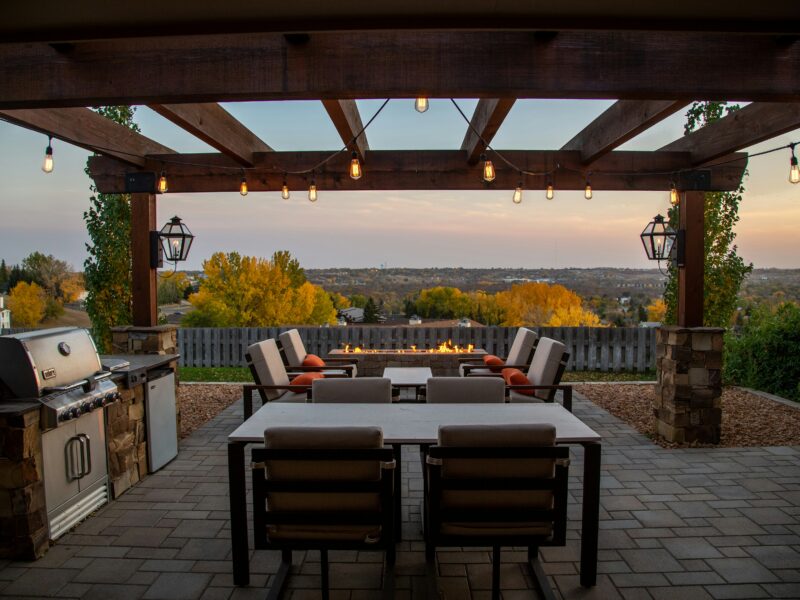
Look, permanent buildings are the best option if you own your house and don’t want to move anytime soon. When a storm strikes, they stay put and increase the property’s value.
The Truth About Pergolas
The backyard world’s Instagram favorite is a pergola. They look amazing. The contentious issue is that a typical open-top pergola doesn’t offer complete shade.
- The Striped Effect: You receive the “striped” sun exposure when you don’t have a cover.
- The Fix: To truly provide shade for backyards that receive excessive amounts of sunlight, a pergola must be equipped with a retractable canopy or a polycarbonate roof.
- Material Matters: Without treatment, wood rots. Although aluminum requires no upkeep, it can have an industrial appearance.
Do it correctly if you decide to install a pergola. Building the frame alone won’t make you feel better. It won’t. The canopy is necessary.
Pavilions and Gazebos
These feature a solid roof, in contrast to pergolas. This is a complete blockage.
- Temperature Drop: All direct UV radiation is blocked by a solid roof.
- Rain Protection: During a summer storm, you can sit outside.
- Cost: These are pricey. In essence, you are constructing a tiny house without walls.
For in-depth comparisons of the construction expenses of these buildings, visit This Old House.
2. Shade Sails
Shade sails are my favorite. Although they appear to be from a posh resort in Tulum, you can purchase them on Amazon for a reasonable price. But they are frequently installed incorrectly.
Why They Work?
Breathable cloth (HDPE) is used to make shade sails. In contrast to a metal roof, they do not retain heat underneath. The region underneath is kept much colder by hot air rising through the fabric.
The Installation Trap
People make mistakes here. They wonder why a flat piece of fabric sags and retains water after attaching it to four poles.
- Hypar Design: The design must be twisted. The diagonal corner is low, while one corner is high—tension results from this.
- Anchor Points: These sails function similarly to enormous kites. A wind of 30 mph will tear out your anchor points if they are not firmly fastened into the earth.
- Coverage: Usually, many coverages are required. It looks cooler and provides better shade when several sails are layered.
Architectural Digest frequently provides excellent structural examples for a thorough examination of wind loads and tension.
3. The “Smart” Choice
Let’s discuss adaptability. You crave the sun sometimes. Perhaps you desire the warmth on a cool October morning. A fixed roof destroys that vibe.
Retractable awnings are superior in this situation.
Motorized vs. Manual
- Motorized: You push a button. Some even have wind sensors that retract automatically if it gets too breezy. This is the luxury pick.
- Manual: You crank it by hand. It’s cheaper, but let’s be honest—are you really going to go out there and crank it every time the sun comes out?
The Heat Factor
Your home’s awnings are attached to the side. They protect your sliding glass doors from the sun. By blocking solar heat gain before it enters the house, this does more than shade the patio—it also reduces your indoor air conditioning expenditure. That adds a great deal of value.
Awnings can cut summertime solar heat gain on west-facing windows by as much as 77%, according to the Department of Energy.
4. Giant Umbrellas (Cantilever is King)
Ignore the tiny umbrella that protrudes from the center of a glass table. For a genuine backyard setup, those are pointless.
A cantilever umbrella is necessary.
Why are they superior?
- Offset Base: The pole is off to the side, not in your face. You can put a whole sectional sofa under the canopy.
- Rotation: Good cantilever umbrellas rotate 360 degrees. As the sun moves from East to West, you spin the umbrella.
- Mobility: Unlike a pergola, you can take this with you if you move houses.
Pro Tip: Do not cheap out on the base. You need heavy weights (sand or water-filled) to keep these upright. A flying umbrella is a lawsuit waiting to happen.
5. Nature’s Air Conditioning: Trees and Vines
The long game is this. However, it is also the most successful game.
The Science of Transpiration
Trees do more than block the sun. Their leaves actively chill the air around them by releasing moisture. Although a metal roof can radiate heat, it blocks the sun. Trees absorb heat.
Fast-Growing Shade Trees
If you don’t want to wait 20 years for shade, look at these:
- Hybrid Poplar: These things shoot up fast.
- Red Maple: Great shade and killer fall color.
- Weeping Willow: If you have the water for it, they create a massive canopy quickly.
The Green Wall
Plant climbing vines if you have a pergola (see part 1). In a year or two, grapevines or wisperia will cover the top. It transforms a building into a living roof. It appears pricey, is cool, and is dense.
To select trees that are native to your area, speak with the Arbor Day Foundation or your local university extension.
6. Curtains and Privacy Screens
The sun doesn’t always shine from above. The sun is coming in sideways at 6 PM, which is referred to as the “Golden Hour” (or the “Blinding Hour”).
A roof won’t help you here.
- Outdoor Curtains: Hang these on your pergola. When the sun dips low, slide them shut. It adds a cabana feel.
- Roller Shades: These are like sunglasses for your patio. You mount them on the beam and roll them down. They cut the glare but let you keep the view.
- Lattice Panels: A fixed wall of wooden lattice blocks the harsh angle of the sun but lets the breeze through.
Assessing Your Specific Situation
Before you buy anything, stop. Go outside. Look at your yard.
- Orientation: Which way does your house face? West-facing backyards get the brutal late-afternoon sun. South-facing gets sun all day.
- Wind Tunnel: Is your yard windy? If yes, skip the giant shade sails unless you hire an engineer. Go for a louvered pergola instead.
- HOA Rules: Don’t build a permanent pavilion before checking with your Homeowners Association. They love to fine people for “unapproved structures.”
The Verdict: What Should You Choose?
So, is the backyard no longer fighting the sun? Not at all.
Build a pergola with louvered panels or a pavilion if you have the funds and want a long-term solution. It is an addition to your house.
Layer three or four shade sails with sturdy steel posts for a stylish yet affordable look.
Invest in a high-end cantilever umbrella if you require flexibility, and plant a Red Maple tree now for the future.
You don’t have to suffer; that’s the point. Investing in shade solutions for overly sunny backyards is an investment in your way of life. Instead of being the house where people leave early because they are sweating through their clothes, you want to be the place where people come to hang out.