In his book The $64 Tomato, author Bill Alexander chronicled his quest to grow the perfect garden, only to realize that after tallying the costs of landscaping, specialized tools, and animal deterrents, each tomato he harvested cost an exorbitant amount.
For many enthusiastic beginners, gardening can quickly become an unexpected money pit. However, cultivating a beautiful, highly productive landscape does not require a massive budget. It requires strategic allocation of resources.
The secret to a thriving, budget-friendly garden lies in knowing the difference between an expense and an investment. By focusing your financial resources on foundational elements that yield long-term benefits, you can aggressively cut costs on the consumables that commercial nurseries push every season.
The Foundation: Where You Must Invest?
When establishing a garden, trying to save money on the foundational elements, such as tools, soil, and water infrastructure, almost always results in higher costs later.
Quality Tools Over Disposable Plastic
Purchasing cheap, big-box-store hand tools is a false economy. A $5 trowel that bends in hard clay will need replacing every spring. Instead, invest your budget in a core set of high-quality tools constructed from carbon, steel, or solid forged metal.
You do not need a shed full of specialized gadgets. A successful gardener can maintain a large property with a carefully curated essential tool collection:
- A solid forged steel spade.
- A sturdy digging fork.
- A hand trowel with a continuous metal tang.
- A high-carbon steel gardening knife (Hori Hori).
- A bypass pruner (secateurs) with replaceable blades.
Maintaining these tools dictates their lifespan. Wiping blades clean of sap and pathogens after pruning, and storing tools out of the weather, ensures a one-time purchase lasts a lifetime.
Building Healthy Soil
The health of your garden ultimately comes down to the health of your soil. Many weekend warriors make the mistake of buying expensive plants and placing them in poor, compacted clay.
Think of your garden soil like a bank account. Plants continually make nutrient withdrawals as they grow; if you do not make regular deposits, the account is eventually depleted, leaving you with dead dirt rather than living soil.
If you are starting a new garden bed, invest in high-quality bulk topsoil and compost rather than buying individual plastic bags from a hardware store. While bulk delivery carries an upfront cost, the per-yard price is drastically lower.
Healthy soil is a subterranean biodiverse environment teeming with billions of microorganisms. These organisms provide nutrients, lock up harmful contaminants, and naturally fight soil-borne pests, drastically reducing your need to ever buy synthetic fertilizers.
Water Management and Smart Irrigation
More plants die from overwatering than underwatering, largely due to poor drainage, displacing oxygen in the root zone, and drowning the plant. Overhead watering also wastes money through evaporation and promotes fungal diseases by keeping foliage wet.
Investing in a proper drip irrigation system saves water, time, and plant replacements. However, you must design it wisely. Hard water can quickly clog expensive micro-drippers and emitters.
A highly effective, budget-friendly workaround is to run 1/4-inch poly tubing and manually drill tiny holes directly into the line next to the root zones of your plants.
Pair this with a reliable digital hose timer (around $25) and a Y-splitter at the spigot. This automated setup delivers a slow, deep soaking precisely where it is needed, establishing strong, drought-resilient root systems.
Where to Save: Cultivating Frugality in the Garden
Once your soil is rich and your irrigation is set, you can drastically reduce your seasonal spending.
Sowing from Seed vs. Buying Transplants
Growing from seed is the single most effective way to save money. A standard $2 to $3 packet of tomato seeds contains 30 or more seeds. To buy 30 individual tomato transplants from a nursery could easily cost over $60.
When buying seeds, you will encounter a choice between hybrid and heirloom varieties. Both have a place in a budget garden, depending on your goals.
| Feature | Heirloom Seeds | Hybrid Seeds |
|---|---|---|
| Cost & Sourcing | Generally cheaper; can be saved year after year for free. | More expensive, proprietary; new seeds must be purchased annually. |
| Genetic Trait | Open-pollinated. Offspring grow true to the parent plant. | Cross-pollinated. Offspring will not grow true to the parent. |
| Yield & Uniformity | Lower yield, variable ripening times, diverse shapes/colors. | High yield, uniform appearance, and all ripen simultaneously. |
| Disease Resistance | Often vulnerable to common soil and foliar diseases. | Specially bred for robust disease and pest resistance. |
| Best For | Flavor, unique varieties, and long-term seed-saving sustainability. | Maximizing harvest in small spaces, bulk preserving, and heavy disease areas. |
If you are gardening in an area prone to harsh fungal diseases, spending a few extra dollars on disease-resistant hybrid seeds can save your entire harvest. However, if your goal is strict self-sufficiency, invest in heirlooms, learn to save your seeds, and never repurchase a packet.
The Seed Library and Grocery Store Strategy
Before buying any seeds, check with your local university extension program or public library. Many communities host “Seed Libraries”—networks where local gardeners donate and swap regionally adapted seeds for free.
You can also leverage your weekly grocery run. Grocery store produce is a massive, untapped seed bank. For example, scraping the seeds out of a single store-bought Kabocha or butternut squash can yield dozens of viable plants.
The same principle applies to cantaloupes and certain tomatoes.
Upcycling Materials for Raised Beds
Lumber is expensive, but raised beds do not require pristine, store-bought cedar. You can build highly productive beds using untreated recycled materials.
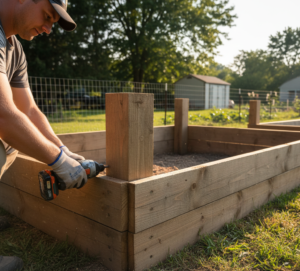
A standard 4×8-foot raised bed can be constructed entirely from reclaimed wood. By sourcing old 2″x8″ fencing planks and a single 4″x4″ post cut into corner anchors, you can frame a sturdy box.
Line the bottom with heavy-duty landscape fabric to suppress weeds before filling it with a bulk soil-compost blend.
If you are buying landscape plants, skip the mature specimens. While a 3-liter potted shrub looks impressive immediately, it carries a premium price tag. Instead, buy the smaller 9-centimeter pots.
Given proper soil and care, the smaller plant will adapt to your native soil faster and typically catch up to the larger plant’s size within three years.
Real-World Case Study: The Frugal Harvest
Consider the return on investment (ROI) of a squash and melon patch built on budget principles.
A gardener invests $65 in an automated, drilled-hose drip irrigation system. Instead of buying seed packets, they save the seeds from a $2 store-bought butternut squash and a $2 cantaloupe.
The seeds are germinated in recycled yogurt containers on a sunny windowsill.
By mid-summer, the four strongest butternut squash plants produce 20 mature squash. At grocery store prices, those 20 squash are worth approximately $40. The cantaloupe vines produce 30 fruits throughout August, valuing roughly $60.
Adding in a 6-pack of yellow crookneck squash purchased on clearance for $3 (which eventually yielded 11.5 lbs of food), the garden produced well over $115 worth of high-value produce.
After subtracting the initial $65 irrigation setup and $7 in seeds and starts, the garden generated a massive ROI in a single season, and the irrigation infrastructure remains in place for years to come.
The Maintenance Trade-Offs: Time vs. Money
A beautiful landscape requires either your money or your time. By substituting commercial products with DIY alternatives, your garden becomes economically sustainable.
Making Your Own Compost and Fertilizer
Buying bags of compost and synthetic fertilizer is a rapid way to drain a garden budget. Instead, turn your yard waste and kitchen scraps into a biologically active soil amendment.
A backyard compost pile requires a balance of carbon-rich “browns” (dry leaves, shredded non-glossy paper, twigs) and nitrogen-rich “greens” (grass clippings, fruit and vegetable scraps, coffee grounds). The ideal ratio is two to three parts brown to one part green by volume.
- Layer: Alternate your greens and browns, ensuring food scraps are always buried under at least four inches of dry leaves to avoid attracting pests.
- Aerate: Turn the pile with a garden fork every few weeks.
- Moisture: Maintain the moisture level of a wrung-out sponge.
When maintained properly, the center of the pile will reach 130°F to 160°F, killing weed seeds and pathogens. In three to five months, you will have dark, crumbly, sweet-smelling compost for free.
For fertilizer, avoid synthetic, salt-based feeds that degrade soil biology. You can make highly nutritious, potassium-rich liquid feeds by steeping comfrey or nettles in a covered bucket of water for a week, then diluting the liquid at a 1:4 ratio with water.
Natural Pest Management over Expensive Chemicals
When pests arrive, the instinct is often to head to the store and buy a chemical spray. This is a costly mistake. Broad-spectrum pesticides indiscriminately kill 97% of insects that are beneficial or neutral, wiping out the natural predators that keep pest populations in check.
Instead, adopt Integrated Pest Management (IPM).
- Level 1 (Cultural/Mechanical): Inspect plants regularly and hand-pick pests like caterpillars and beetles off your foliage.
- Level 2 (Biological): Encourage beneficial insects like lady beetles and parasitic wasps by planting diverse, nectar-rich flowers.
- Level 3 (Targeted Organic): If an infestation threatens the crop, use highly specific organic controls. For example, apply Bacillus thuringiensis (Bt) to target destructive caterpillars without harming bees, or use Spinosad, a natural soil bacterium derivative, as a last resort for severe outbreaks.
Common Budget-Busting Mistakes to Avoid
Even well-intentioned gardeners throw money away by falling into common landscaping traps. Keep this checklist in mind to protect your investments:
- The Mulch Volcano: Mulch suppresses weeds and retains soil moisture, reducing water bills. However, piling thick mounds of mulch directly against the trunk of a tree (a “mulch volcano”) traps moisture against the bark. This invites rot, disease, and pests, eventually killing an expensive tree. Keep mulch 2 to 3 inches thick, and pull it away from the base of the plant.
- Ignoring Mature Spacing Requirements: The desire for an instantly full garden often leads to planting too closely. As plants mature, they compete for light and nutrients, drastically reducing airflow. This poor circulation is a primary driver of fungal disease. Always space plants based on their mature dimensions, not their seedling size.
- Improper Placement (Right Plant, Right Place): Planting a shade-loving Hosta in the blistering afternoon sun guarantees a slow, expensive death for the plant. Always map your yard’s sunlight patterns before purchasing plants.
Final Thoughts
You don’t have to cut corners to garden on a budget; you need to know where the real value is in gardening. The garden takes care of itself if you spend a lot of money on long-lasting tools, organic soil structures, and good water management.
By saving seeds, reusing materials, and composting at home, you can turn gardening from an expensive yearly hobby into a very profitable and fulfilling way of life. In the end, your own shadow is the most important thing you put in your garden.