I wanted to publish this article right after I tried out the newest battery-powered mowers this spring. We put this off because we were deep into comparing string trimmers last week.
Before we go into the details, I want to remind you what we’re actually talking about today. We’re not just talking about torque or horsepower. We are answering the only question that really counts for your weekend: Which mower gets you back to the sofa the fastest?
The “Time” Myth in Lawn Care
People always ask me the same question: “What about power?” “More power means faster mowing,” some say. But I don’t know if that’s accurate. Does a louder engine actually make you do the work faster?
From my point of view, raw might is only part of the picture. Why? Here’s the easiest proof I can provide you.
If your gas mower cuts 10% faster but takes you 15 minutes to start, maintain, and fill up, have you really saved time? No. You just moved it to a different place.
We might agree that gas cuts thick grass better, but we might not agree on how long the battery lasts. But the calculation takes into account the whole experience of owning something. This gets us to the main point of the season.
No matter how big their yard is, every homeowner wants to finish mowing the lawn in less than an hour. One of the cool things about the new electric mowers is that they turn on right away.
But the people who really love gas are the same ones who boast, “I can mow for three hours without stopping.” And they are right. Your Saturday is spoiled if you have to wait for a battery to charge.
1. Setup and Prep: The “Get Up and Go” Factor
Let’s begin with the first step: getting the machine to work. This is where the fight between gas and electric lawnmowers starts, even before you cut a single blade of grass.
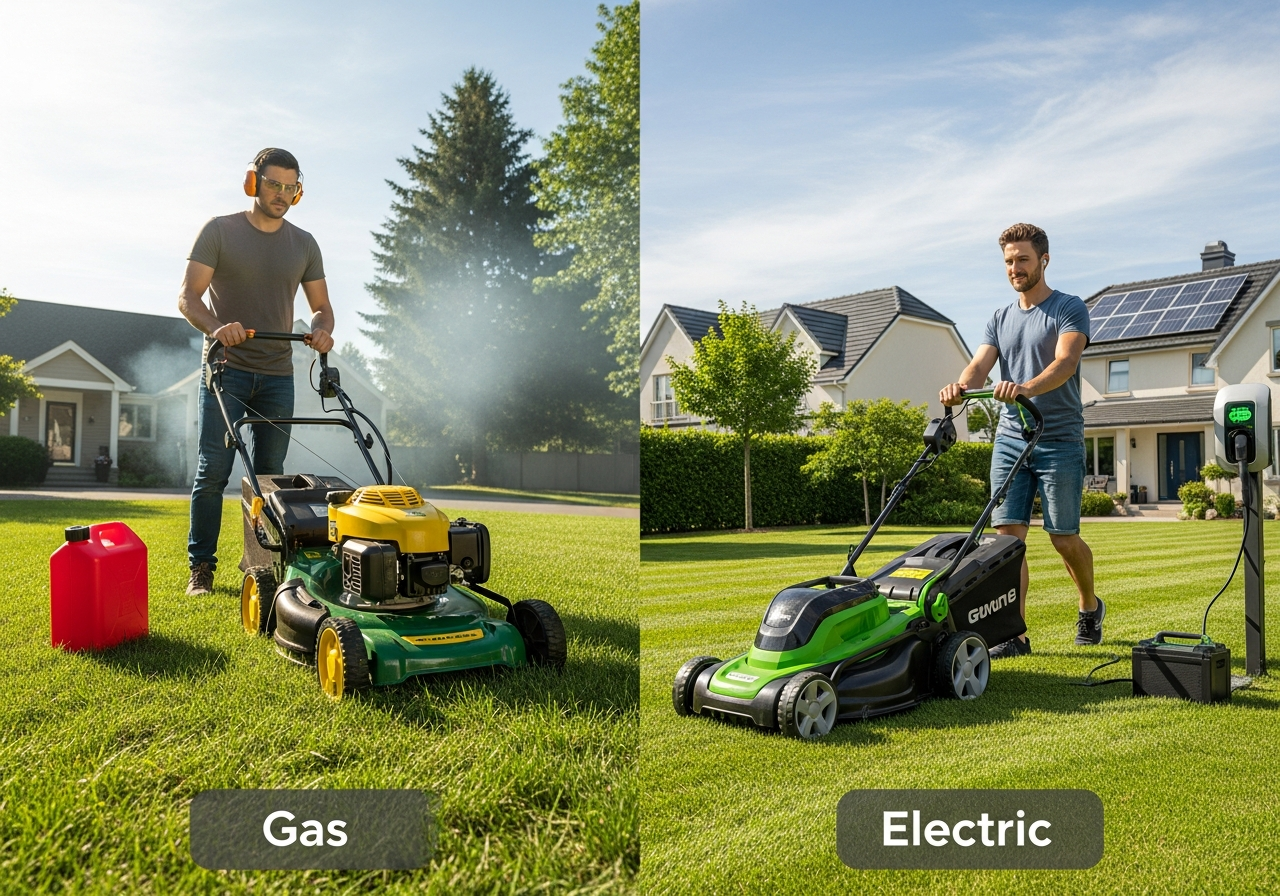
The Gas Ceremony
You know what to do if you have a gas mower. It’s a ritual. You look at the oil. You look at how much gas there is. You hope the carburetor isn’t clogged if this is the first time you’ve mowed this year.
- You have to go to the gas station to fill up. You need to fill the jerry can. You need to pour it without spilling.
- The Pull Cord: It can start on the first pull. Sometimes it takes five.
- The Warm-up: You normally let it sit for a minute before you push it.
The Electric Edge
Now, take a look at the electric side. It’s just a big piece of equipment. You plug in a battery, push a button, and hold the bar.
- No priming, no choking, and no pulling to start right away. There is no “push and go.”
- No fluids: You don’t have to check the oil or mix the fuel.
The Winner: Electric
Electric mowers save you 10 to 15 minutes of prep time every weekend. That adds up to hours of your life that you don’t spend smelling like gas over the course of a season.
2. Cutting Speed: Who Chews Through Grass Faster?
Now, the second axis is how well you did in the field. Gas has always been the most popular here.
Gas Mowers: The Power
Gas engines provide a lot of torque. A gas mower normally doesn’t slow down when it hits a section of damp, thick fescue.
This implies you can walk more quickly. You don’t have to slow down so the blade can catch up. If you’re mowing a property that hasn’t been taken care of and has weeds up to your knees, gas is the only sensible choice.
Electric Mowers: The Smart Way
The newer electric mowers, notably the 60V and 80V models, are getting better. A lot of them now have “load-sensing” technology. When they see dense grass, they speed up the blade.
But they can get stuck in incredibly thick things. You have to walk a lot of the time to keep the motor from stopping.
Gas is the winner.
Gas wins if we’re only talking about how fast you can walk across the grass. You may stroll quickly without having to worry about the engine dying. Gas is still the best for pure cutting speed.
Note: Consumer Reports says that high-voltage battery mowers are now as good as gas mowers in normal situations, although gas mowers are still better in very thick grass.
3. The Refueling vs. Recharging Dilemma
Here’s the deal: this is the most important thing for most individuals.
The Gas Station
It takes around two minutes to fill up a gas mower. You pause, take off the cap, pour, put it back on, and pull the cord. You can start mowing again right away.
The Wall of Batteries
You’re done if your battery fails in the middle of the grass. If you don’t have a second battery charged and ready, you’ll have to wait 40 to 60 minutes.
- You won’t run out of juice if your yard is less than half an acre.
- If you don’t have backup batteries, electric is a waste of time in large yards (over 1 acre).
The winner is: It depends
Electric wins if you have enough batteries to do the work (no downtime). Gas beats electric in this area if you have to stop and charge.
4. Maintenance: The Hidden Time Thief
This is the part that no one wants to talk about, but we have to. The “hidden” expense of time that comes with owning a mower.
Checklist for Gas Maintenance
- Change the oil once a season (30 minutes).
- Checking and changing air filters (10 minutes).
- Changing spark plugs every so often (15 minutes).
- Winterizing: Getting rid of fuel or adding stabilizer so it starts up again in the spring (20 minutes).
- Going to the mechanic: Eventually, something will break that you can’t fix.
Checklist for Electric Maintenance
- Sharpening the blade: same as gas.
- Taking care of batteries: Keep them inside during the winter.
That’s all. That’s everything on the list.
Electric is the winner.
There is no competition here. You have to take care of gas mowers for hours every year. Electric mowers need very little. You need to think about this if you care about your weekends.
Where Does The Time Go?
To make this very evident, let’s look at how much time it takes to mow a regular 1/3 acre lot.
| Activity | Gas Mower Time | Electric Mower Time |
| Prep (Check fluids/fuel) | 5 Minutes | 1 Minute |
| Starting the Mower | 2 Minutes | 0 Minutes |
| Cutting Time | 40 Minutes | 45 Minutes |
| Refueling/Swapping Battery | 2 Minutes | 1 Minute |
| Clean Up/Storage | 5 Minutes | 2 Minutes |
| Total Time | 54 Minutes | 49 Minutes |
You can see that the electric mower saves time on both ends, even if the gas mower cuts a little faster.
When Does Gas Actually Save Time?
I don’t want you to believe I’m just talking up electric. In some cases, gas is the only way to save time.
If you have more than one acre of land, electricity becomes a huge pain in the neck. You will need three or four batteries. You will be changing them all the time.
For big properties, a gas tank (which is easy to replace) lasts longer than a battery. If you’re mowing a farm or a big estate, gas is the way to go. It’s not worth the time you lose changing and taking care of batteries.
Gas also saves time if you let your grass grow for three weeks at a time. When you mow long grass with an electric mower, you have to make two passes. Gas does it all at once.
The Verdict: Which Mower Should You Buy?
Now it’s time to make the final choice: Who wins and why?
Thanks a lot to the gas engine; it’s been a great help for 100 years. But let’s face it: the time of the carburetor is coming to an end for most homeowners.
If you want an electric mower, consider choosing one.
- Your yard is less than half an acre.
- You don’t like doing maintenance or getting your hands filthy.
- You want to be able to push a button and be done.
- Time Saved: High (since there is no maintenance).
Choose a Gas Mower if:
- You have a huge yard (more than an acre).
- You often let the grass get too tall or too moist.
- You want raw power and don’t care about the noise.
- Time Saved: High (only for big, hard properties).
My Opinion
The “time” isn’t merely the minutes on the clock for me. It’s about the rubbing.
I can use my electric mower to mow for 10 minutes before dinner to clean up. I would never do that with a gas mower because it’s such a pain to start.
Electric lets you mow when you want, without all the fuss. That’s the best way to save time in my book.
Frequently Asked Questions
Do electric mowers last as long as gas?
Batteries typically last 3-5 years before needing replacement. A well-maintained gas engine can last 10+ years, but requires significantly more annual work to keep running.
Is it cheaper to charge a mower or buy gas?
Electricity is much cheaper. According to the Department of Energy, charging a battery costs pennies compared to the rising cost of gasoline.
Can electric mowers cut wet grass?
They can, but not as well as gas. Wet grass clumps up under the deck and drains the battery faster. It is better to wait for the lawn to dry.
What is the best electric mower brand?
Brands like EGO, Milwaukee, and Ryobi are currently leading the pack in terms of battery technology and reliability.