
Creating a dedicated space for your creative endeavours is a significant shift in how you operate. Anyone who has repeatedly packed away half-finished canvas paintings from the dining table or picked up wood shavings from a driveway understands the friction that a temporary setup causes.
A permanent, purpose-built hobby space eliminates the setup and teardown penalty, allowing you to get right into a state of flow.
Creating this space entails more than simply shoving a desk into the corner. Whether you’re establishing a soundproof recording studio, a dusty woodworking shop, or a peaceful crafts refuge, success depends on proper environmental engineering.
You must consider structural integrity, acoustic decoupling, light temperature, and ergonomic storage.
Choosing the Right Footprint
The first major hurdle is identifying where this space will live. You generally have three realistic options in a standard home, each carrying distinct structural trade-offs.
| Space Type | Best Suited For | Primary Trade-Off | Key Infrastructure Need |
|---|---|---|---|
| Garage | Woodworking, metalworking, automotive, messy arts. | Temperature volatility. | Upgraded insulation and heavy-duty damp proofing. |
| Loft / Attic | Sewing, writing, painting, and quiet crafts. | Access difficulties and structural floor loads. | Loft boarding and reinforcement. |
| Spare Room | Digital arts, scale modeling, reading/music. | Limited square footage. | Acoustic management so noise doesn’t bleed into adjacent bedrooms. |
Garages are often the default for heavy hobbies because they separate noise and dust from the main living quarters. Lofts, on the other hand, offer profound seclusion and quiet, making them ideal for high-focus tasks, though moving large materials up a loft ladder can be prohibitive.
The Structural Shell: Insulation and Building Standards
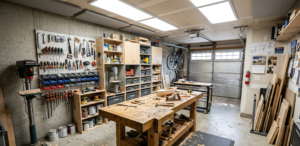
If you are converting a raw space like a garage, establishing a controlled climate is non-negotiable. Drafty, damp rooms destroy delicate materials and ruin tools through rust.
When constructing infill walls (for instance, replacing a garage door), industry building standards dictate strict thermal performance. New walls should achieve a U-value not exceeding 0.18 W/m²K. In practical terms, this typically requires a buildup of 100mm blockwork, 100mm of high-quality insulation, and an inner 100mm blockwork skin.
Floors in outbuildings or garages are usually 100-150mm lower than the main house and sit directly on the earth, acting as a massive thermal bridge.
Upgrading the floor requires a damp-proof membrane (liquid or sheet) linking directly to the wall’s damp-proof course, topped with roughly 100mm of polyurethane foam insulation and finished with an 18mm tongue-and-groove chipboard or a 65mm reinforced screed.
If your room does not have a direct exit to a main hallway, fire safety regulations require an escape window. This window must provide an unobstructed open area of at least 0.33m², with minimum dimensions of 450mm in both height and width, positioned 800-1100mm above floor level.
Acoustic Isolation: Managing Noise Bleed
Keeping your noise in and the household’s noise out is a matter of mass and decoupling. If you are building a music room or running power tools, basic drywall will not stop low-frequency sound waves.
Effective soundproofing relies on building a “room within a room.” This means constructing a secondary stud frame (often using 6″ x 2″ timber for heavy load-bearing capacity and a deep air gap) that physically does not touch the existing external walls.
To decouple the inner walls from the timber frame, install resilient channels and thin metal rails that run horizontally across the studs. Acoustic plasterboard, which is significantly denser and heavier than standard drywall, is then screwed into these channels rather than the wood.
This allows the wall to act like a spring, flexing slightly to absorb acoustic energy before it transfers into the building’s main structure.
Use a specialized acoustic sealant heavily during construction. Applying it between layers of plasterboard creates a constrained-layer damping effect, further absorbing vibration. A heavy-duty, dense door is also critical; a hollow-core interior door will leak sound instantly.
A custom studio door built from a 2-inch stud frame, packed with insulation, and faced with 18mm OSB and 1.5-inch dense chipboard can weigh over 50kg, but it will dramatically reduce sound transmission.
Environmental Controls: Air Quality and Chemical Safety
Hobbies involving resins, soldering, paints, or wood dust introduce serious respiratory and fire hazards. Relying on an open window is rarely sufficient.
Adopt the industrial “Hierarchy of Controls” for your home workspace. The most effective step is substitution: swap highly toxic materials (like oil-based paints containing heavy metals or chlorinated synthetic waxes) for safer alternatives like water-based finishes and zero-VOC paints.
When handling materials that emit volatile organic compounds (VOCs) or fine particulates, mechanical ventilation is required. Passive vents are not enough.
Extractor fans should be sized appropriately; a dedicated hobby room handling chemicals or heavy dust needs mechanical ventilation capable of high exchange rates (utility rooms legally require at least 30 liters per second, but dust extraction should be much higher).
If your space is acoustically sealed, standard vents will leak noise. To maintain soundproofing while getting fresh air, construct a baffle box, a sealed wooden box lined with acoustic insulation containing an S-shaped tunnel. The ventilation duct passes through this serpentine path, allowing air to flow while trapping sound waves.
Fire Safety Protocol: If you work with linseed oil or oil-based solvents, never leave soaked rags crumpled on a workbench. They undergo an exothermic reaction as they cure and can spontaneously combust. Always place solvent-soaked rags into a dedicated metal container or a garbage bag filled with enough water to submerge them completely.
Lighting for Precision and Comfort
The single most overlooked aspect of a home hobby space is adequate lighting. Poor lighting causes eye strain, leading to costly mistakes and fatigue.
General room lighting (often measured at around 200 to 300 lux for a standard workspace) is not sufficient for detailed work. If you are working on machines, you need at least 500 lux, while highly detailed tasks like jewelry making, scale modeling, or wood veneering demand upwards of 750 lux.
Color temperature is equally important. It is measured in Kelvin (K). While a cozy living room uses warm light (around 2700K to 3000K), your active work zones should be equipped with neutral to daylight-white bulbs ranging from 3500K to 5500K.
This spectrum mimics natural daylight, allowing for accurate color rendering when painting or finishing materials.
To eliminate shadows cast by your own body or tools, arrange overhead LED tubes or panels in a crisscross or zigzag pattern. Supplement overheads with pinpoint task lighting.
For example, a magnetic gooseneck lamp attached to a bandsaw or lathe allows you to direct light exactly where the blade meets the material. Because LEDs generate almost no heat, you can position them inches from your hands without discomfort or risking warping wet materials.
Ergonomics and Vertical Organization
The floor is the most expensive real estate in your room. A sprawling, horizontal setup quickly becomes a cluttered mess. Shifting to a vertical organization strategy fundamentally changes how the room operates.
Divide your wall and cabinet space into three distinct ergonomic tiers:
- Prime Real Estate (Eye to Chest Level): Reserve this highly accessible zone for the tools and materials you touch in 80% of your projects.
- Specialty Storage (Above Shoulder & Below Knee Level): Use this for heavy, bulky items, seasonal tools, or materials you only access once a month.
- Deep Storage (Highest Shelves): Dedicated strictly to archival materials or bulk refills kept in uniform, labeled bins.
Do not ignore negative space. The inside panels of heavy cabinet doors are excellent locations for adhesive hooks to hold lightweight tools, rulers, or cables.
Whenever possible, opt for modular, reconfigurable furniture. Lock-in, built-in desks are rigid. Using foldable table systems or mobile work units on heavy-duty casters allows you to pull a table into the center of the room for a large assembly project, then push it against the wall to open up floor space for messy finishing work.
Interior Design: Making the Space Inviting
A hobby room should not feel like a sterile laboratory unless that specific aesthetic gets your creative gears turning. The visual weight and color of the room subtly dictate your mood.
When painting, apply the 60-30-10 rule: dedicate 60% of the room to a dominant, calming hue, 30% to a secondary color (like your cabinetry or desk), and 10% to vibrant accent shades (tools, artwork, or chairs).
Consider the psychological impact of color temperature in your decor:
- Frosty Minimalism: Relies on crisp whites, muted blues, and pale ash woods. Cool colors visually recede, making small spaces feel expansive and enhancing sharp focus.
- Toasty Maximalism: Embraces terracotta, deep greens, rich walnut woods, and brass. Warm tones absorb light and visually advance, condensing the space to make it feel deeply intimate and creatively energized.
Case Example: The 19-Square-Meter Studio Build
To put these elements into perspective, consider a recent real-world build where a creator converted a 3.5m x 5.5m space within an industrial brick unit into a soundproof mixing and rehearsal studio.
Because the brick provided baseline mass, the focus shifted to decoupling. The builder constructed an independent 6×2 timber frame inside the shell, leaving an air gap.
They utilized AC50 acoustic sealant extensively, spending roughly £200 on sealant alone to create airtight, flexible joints between heavy acoustic plasterboard layers. They packed the cavities with 4-inch Rockwool RW5 insulation.
Instead of buying a commercial acoustic door, they engineered a heavy double-door system with a 1.5-inch air gap, isolated with neoprene rubber, ensuring no vibrations passed directly through the frame.
Incorporating custom baffle boxes for ventilation allowed fresh air to cycle without compromising the acoustic envelope. Executed largely solo over a year, the material cost landed around £4,500. This demonstrates that professional-grade isolation is achievable on a consumer budget if you apply the physics of mass, air gaps, and decoupling correctly.
The Long-Term Value of a Dedicated Space
Committing to the creation of a permanent hobby room requires a significant amount of time, labour, and money. However, the benefits are readily apparent the first time you leave a complex project sitting as is, switch out the lights, and walk away. When you come the next day, no setup is required. Pick up the tool and resume.
You may stop fighting your surroundings by taking the time to design good lighting, control air quality, install complex sound barriers, and organise vertically. The room no longer serves as a storage space and instead becomes an active participant in your creative process.