Using yesterday’s junk mail to make tomorrow’s heirloom notebook is quite magical. I have spent a lot of time at the vat, and the sewing cradle as a bookbinder and papermaker, and I have learned that a homemade notebook is only as good as the sum of its parts.
If the paper strands are weak, even a beautifully sewn binding will fall apart quickly. Also, sheets that are perfectly formed will buckle if they are folded against their natural grain.
Making a notebook by hand out of recovered paper is both a useful art project and a way to reduce waste. You need to know how cellulose works, be willing to put in some hard work, and be very patient.
Phase 1: The Alchemy of Waste Paper
Making paper at home transforms discarded materials into customizable sheets with distinctive textures. However, not all waste paper is created equal. The foundation of a strong notebook page lies in the quality of the pulp and the integrity of the fibers.
Selecting and Preparing the Pulp
Your choice of scrap paper dictates the strength and color of your final sheet. Standard printer paper, tissue, and newsprint make excellent bases. Avoid glossy magazine pages; their plastic and clay coatings prevent proper fiber bonding and create weak spots in the finished sheet.
If you choose to use newspaper, which has shorter, weaker fibers, mix it with at least 50% printer paper to improve the overall strength and reduce ink transfer.
The Pulping Process:
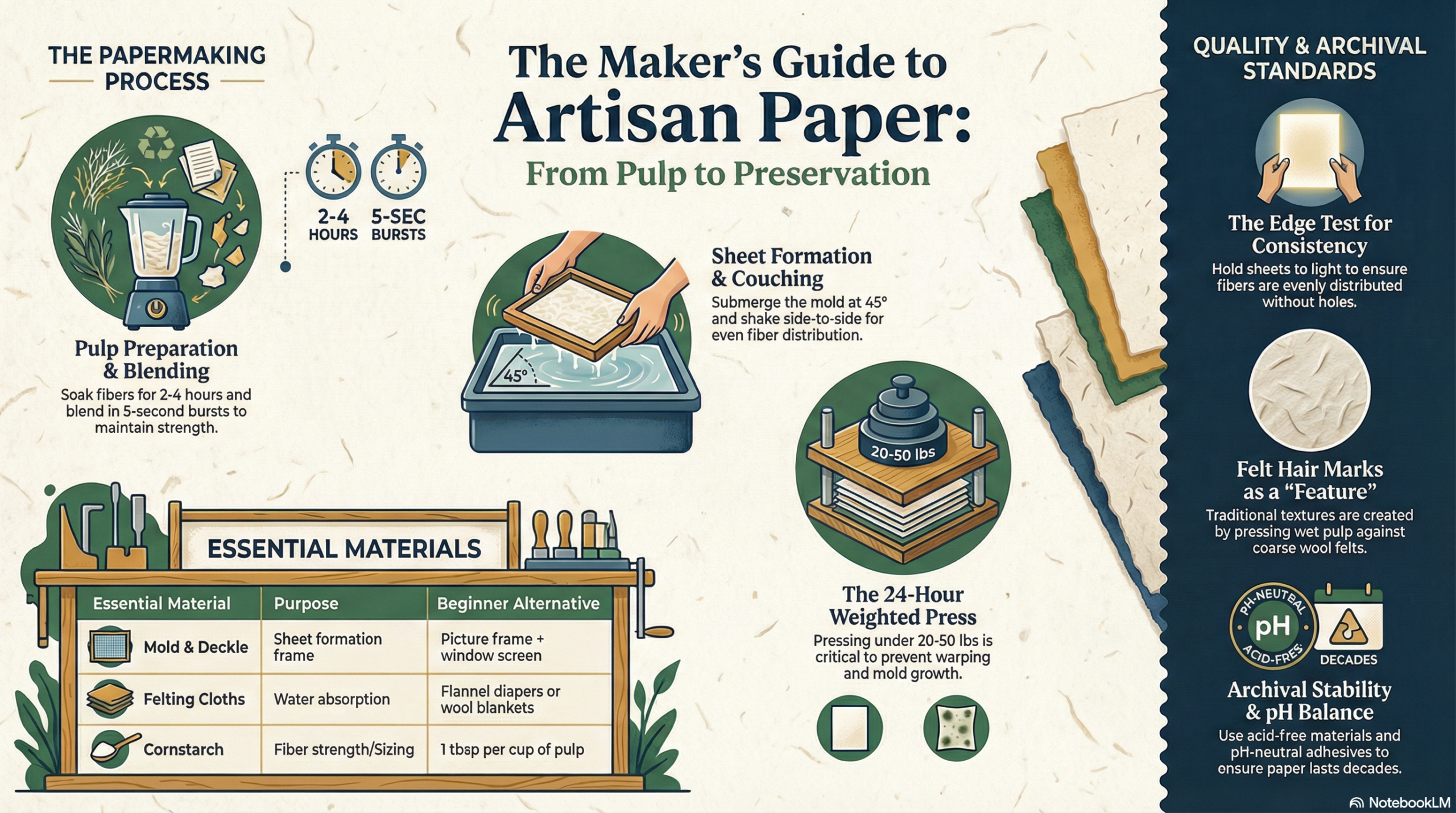
- Shredding and Soaking: Shred 1 to 2 cups of your selected paper into 1-inch pieces. Soak these pieces in room-temperature water for 2 to 4 hours. This resting period allows the fibers to naturally separate and swell, initiating the breakdown of the paper without mechanical force.
- Blending: Transfer the soaked paper to a blender with 4 cups of water. Blend in short, 5-second bursts for a total of 15 to 30 seconds until smooth.
- The Secret Ingredient: Add 1 tablespoon of cornstarch per cup of pulp. Skipping the cornstarch is a common error; it acts as an internal sizing agent and significantly improves the wet strength of the paper during the drying phase.
Trade-off note: It is tempting to over-blend the pulp to achieve a perfectly uniform slurry. However, over-blending mechanically chops the cellulose fibers too short, destroying their degree of polymerization (DP). Shorter fibers result in brittle, fragile paper that will likely tear when folded into book signatures.
Forming, Couching, and Pressing
Once your vat is prepared (maintain a water depth of about 1 inch and a temperature below 80°F to prevent fiber clumping), submerge your mold and deckle at a 45-degree angle. Lift it steadily while gently shaking side-to-side to distribute the fibers evenly across the screen.
After the water drains vertically, you must “couch” (transfer) the wet sheet onto an absorbent felting cloth, such as a flannel diaper or wool blanket. The texture of this felt will permanently imprint onto the wet paper.
Historically, Renaissance papermakers used coarse, non-woven wool felts (often from Navajo-Churro sheep breeds) to create a distinct, toothy texture that gripped drawing chalk beautifully. If you desire a smoother finish for writing, use a tightly woven, smooth synthetic felt.
The Crucial Pressing Stage: Stack alternating layers of wet paper and felt into a “post.” Press this stack under 20 to 50 lbs of weight for a minimum of 24 hours.
Never skip or rush the pressing stage. Insufficient pressing leaves too much water in the sheets; as this water evaporates, it creates surface tension that snaps weak fiber bonds, causing the paper to tear as it dries.
Rushing this step or leaving the sheets in a damp environment can also lead to mold growth. After 24 hours, peel the sheets from the felts and air-dry them individually on mesh screens for another 24 to 48 hours.
Sizing for Pen and Ink
Handmade paper in its raw, “waterleaf” state acts like a sponge. If you attempt to write on it with a fountain pen, the ink will feather and bleed uncontrollably.
To prepare your paper for journaling, you must apply a surface size. Brush the dried sheets with a 1:4 gelatin-to-water solution. This mimics the traditional “tub-sizing” process, where sheets were dipped into warm animal hide glue to create a hard, impenetrable surface.
Once the gelatin dries, the paper will crisp up, exhibiting a satisfying “rattle” and easily accepting liquid inks.
Phase 2: Preparing the Signatures
Before a single hole is punched, the paper must be folded into signatures (groups of nested folded pages). Here, we encounter the golden rule of bookbinding:
Grain direction.
All machine-made paper and some handmade papers, depending on how the water flows across the mold, have a grain direction, which is the alignment of the cellulose fibers. To ensure your book opens smoothly and the pages do not buckle over time, the grain direction must run parallel to the spine.
You can test this by gently bending the paper horizontally and then vertically; the direction that offers the least resistance is the grain.
A Practical Layout for A5 Notebooks
If you are using a standard 12″ x 18″ papermaking mold, you can easily yield signatures for an A5 notebook (roughly 5.8 x 8.3 inches).
| Book Size | Folded Dimensions | Minimum Sheet Size for Signatures | Grain Direction | Yield |
|---|---|---|---|---|
| A5 | 5.8 x 8.3 in | 12″ x 18″ | Long | 2 signatures/page |
| A6 | 4.1 x 5.8 in | 8.5″ x 14″ | Long | 2 signatures/page |
Group your folded sheets into signatures. For handmade paper, which tends to be thicker and more rigid than commercial paper, I recommend grouping no more than 4 sheets (yielding 16 pages) per signature.
Use a traditional bone folder to crease the folds sharply. Trim the three outer edges (fore-edge, head, and tail) using a sharp craft knife and a heavy ruler so the text block is uniform.
Phase 3: The Binding Process
To complement the raw, organic aesthetic of recycled paper, an exposed-spine binding is an excellent choice. While the Coptic stitch offers a beautiful braided spine and allows the book to lie entirely flat, the Long Stitch is historically significant, highly durable, and excellent for beginners.
The long stitch utilizes a “limp structure,” meaning the cover is made from a single, flexible piece of heavy material rather than rigid, glue-covered binder’s board.
Selecting a Sustainable Cover
For a truly eco-friendly notebook, bypass traditional animal leathers and explore plant-based leather alternatives.
- Piñatex: Made from discarded pineapple leaves, this material is felted into a strong substrate that mimics the flexibility of leather.
- Cork Leather: Harvested regeneratively from cork oak trees, it is naturally water-resistant and provides a sturdy, tactile wrap for a limp binding.
Step-by-Step Long Stitch Implementation
Materials Needed:
- 10 prepared signatures of recycled paper.
- Limp cover material (e.g., Piñatex or Cork) cut to size with a fold-over flap.
- Bookbinding awl.
- Pure linen thread, waxed (size 18/3 or 25/3 offers high tensile strength).
- Straight sewing needle (large eye, ~70mm).
Implementation:
- Create a Sewing Template: Cut a piece of scrap paper to the exact height of your signatures. Fold it in half vertically. Mark 5 evenly spaced sewing stations along the crease.
- Pierce the Signatures: Open each signature to its center fold, place the template inside, and pierce through the marked stations using your awl. A punching cradle helps maintain accuracy.
- Prepare the Cover Spine: Measure the exact thickness of your stacked signatures (the text block). Score and fold two parallel lines down the center of your cover material to match this spine width.
- Cut the Spine Slots: Using your template, mark the 5 stations across the spine of the cover. Cut horizontal slots (about 1mm wide) across the spine at each station. These slots will house the exposed thread.
- The Sewing Path: You will sew the signatures directly to the cover, starting from the last signature at the back of the book.
- Thread your needle, leaving a 5-7cm tail on the inside of the signature at Station 5 (bottom).
- Pass the needle out through the cover slot, loop it over the outer edge of the cover, and bring it back inside. Tie a “kettle stitch” knot around the tail to anchor the thread securely.
- Weave in and out through the signature and cover slots, moving up the spine.
- When you reach the top (Station 1), loop around the edge, close the signature, and place the next signature on top.
- Enter Station 1 of the new signature and weave your way back down.
- Finishing: Repeat this serpentine motion until all signatures are attached. Tie off the final thread with a double-knot stitch inside the first signature.
Real-World Case Study: The “Bleed and Break” Disaster
During a community workshop I hosted a few years ago, a student attempted to bind an intricate sketchbook. She had enthusiastically blended her recycled paper pulp for several minutes to get it “perfectly smooth” and skipped adding cornstarch, assuming it was an optional filler.
When she began sewing a tight French link stitch, the thread sliced entirely through the paper folds; the paper had no wet strength during the drying phase, and the over-blended cellulose chains were too short to withstand the tension of the linen thread.
When she attempted to title the cover page, her fountain pen ink instantly spider-webbed across the un-sized page.
We remedied the situation for her next batch by utilizing 5-second blending pulses, adding the necessary starch, and applying a gelatin surface size. We also switched her binding to a Singer-sewn method, utilizing an industrial sewing machine to stitch a single, thinner signature directly through the fold.
The resulting notebook was robust, functional, and completely ink-proof.
Common Bookmaking Mistakes
Even seasoned crafters fall into familiar traps when mixing papermaking and bookbinding.
Keep an eye out for these specific failures:
- Using the Wrong Adhesive: If you decide to add endpapers to a hardbound book, never use standard craft glue. Always opt for a pH-neutral, acid-free Polyvinyl Acetate (PVA) like Jade 403. It remains permanent and flexible when dry, preventing the spine from cracking. If reversibility is required for conservation, use an Ethylene Vinyl Acetate (EVA) like Jade R.
- Ignoring the “Back Mark”: When drying paper over a rope or line (a technique used in traditional lofts), the paper develops a crease called a “back mark”. If you don’t align this crease with the gutter (spine) of your book, the pages will drape awkwardly and resist lying flat.
- Over-tensioning the Thread: Pulling the waxed linen thread too tightly during a long stitch or pamphlet stitch will rip the paper at the sewing stations, especially if the handmade paper lacks structural sizing.
Conclusion
Crafting a book entirely from scratch, from pulping the waste paper to tightening the final knot stitch, is a labor-intensive but deeply rewarding process. You dictate the texture, the weight, and the drape of every single page.
By respecting the natural properties of the cellulose fibers and taking the time to press, size, and align your materials properly, you elevate simple household recycling into the realm of enduring craftsmanship.
FAQs
Can I use a blender that I also use for food to make paper?
It is highly recommended to purchase a cheap, secondary blender sourced from a thrift store specifically for papermaking. Even with thorough washing, microplastics from coated papers and residual inks can remain in the pitcher.
How long will a notebook made of recycled paper last?
Standard DIY recycled paper will last 10 to 20 years if stored away from extreme humidity and direct sunlight. Because every day, printer paper and newsprint contain acidic impurities, the paper will eventually yellow. To increase its archival lifespan, you can add 1 teaspoon of calcium carbonate per cup of pulp to act as an alkaline buffer and neutralize acids.
Is hand-sewing actually as strong as machine binding?
Traditional hand-sewn bindings, particularly those utilizing kettle stitches and heavy waxed linen thread, create an interlocking mechanical grip that allows the book to flex dynamically without breaking. Commercially glued “perfect bindings” (like modern paperbacks) dry out and crack over time, whereas a sewn book can last centuries.