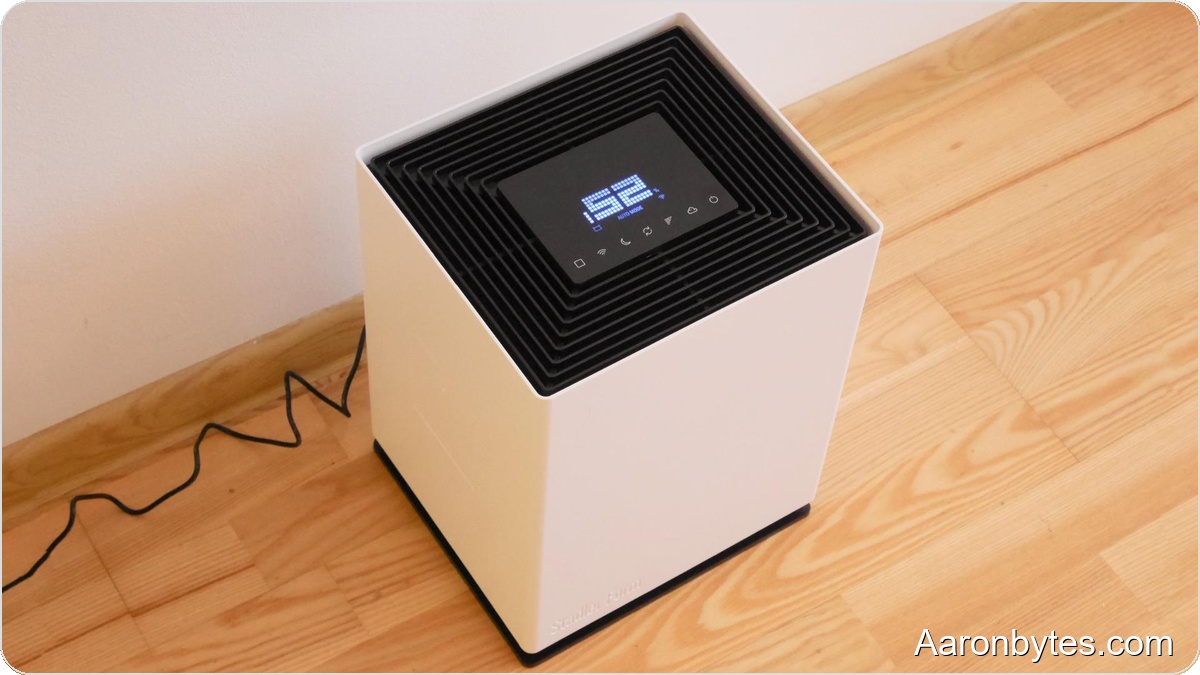
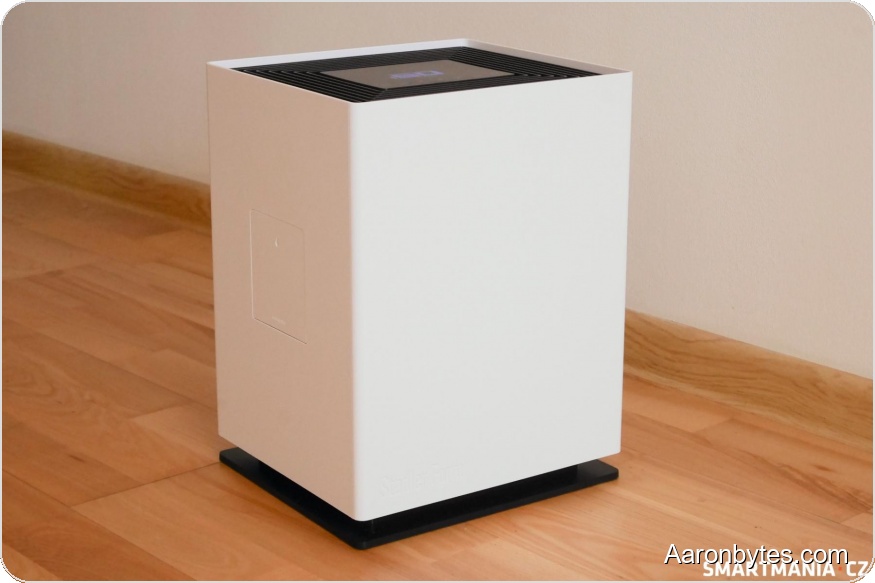
Noah adopts a minimalist square profile measuring 249 × 327 × 221 mm and weighing 3.3 kg empty, making it easy to move from room to room. The matte white plastic finish reads premium and unobtrusive, fitting everything from modern apartments to kids’ rooms.
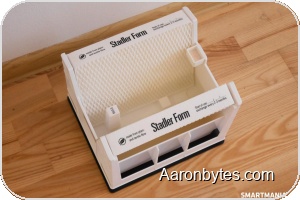
The top section is black and houses an LED touch display with several backlight modes. Under that sits the fan, and the entire upper panel detaches to reveal the filters and the water tank. The tank holds 3.6 liters and includes a small recess for aromatic oil that evaporates during humidification. The manufacturer also sells a selection of essential oils.
Build quality is high: no sharp edges, tight seams, and materials that resist fingerprints. Compared with cheaper plastic units, Noah feels more robust and leans into a design language that evokes Swiss precision.
Specs and features
Noah delivers up to 800 g/h of humidity while drawing 2–36 W, and it runs on five intensity levels, including a turbo mode that can raise relative humidity from 30% to 50% within an hour. A built-in hygrometer drives an Adaptive Humidity automatic mode that maintains set levels without manual intervention.
The manufacturer rates effective coverage up to 110 m², and in open-plan setups, it can service more than one room. In real-world testing, the unit behaved as advertised; I monitored ambient conditions with air-quality monitors in three rooms and saw fast stabilization of humidity.
A notable feature is that Noah humidifies without producing visible vapor. Noise ranges from a whisper-quiet 27 dB at night to about 62 dB at maximum, which is noticeable and can interfere with TV watching. Turbo mode, however, typically only needs 15–20 minutes to significantly raise humidity. The unit includes an auto shutoff on an empty tank and a filter-replacement indicator. The filter captures dust, pollen, and hair, improving air quality without producing white dust.
On its lowest setting, Noah can run overnight in a bedroom without disturbing sleep. The automatic mode kicks in when humidity drops below your set threshold, and most controls are available through the mobile app.
Why a humidifier matters?
During heating season, roughly November through March, indoor air can fall to 20–30% relative humidity. Maintaining 40–60% helps prevent irritated airways, dry coughs, cracked skin, and worsened asthma. Higher humidity also reduces airborne dust circulation and static buildup, protects wood furniture and plants, and lets you lower thermostat set points for energy savings.
Even homes with mechanical ventilation can experience low absolute humidity on very cold days after air is heated indoors, so a humidifier remains useful in those setups.
In practical use, Noah excels at quickly stabilizing humidity through natural evaporation across a replaceable filter that also removes allergens. The 3.6-liter tank can last up to 48 hours in automatic mode, minimizing refills during heavy winter use. Turbo refreshes dry air after returning home, while a quiet night mode supports better sleep thanks to improved mucous membrane hydration.
Maintenance is straightforward: replace the filter every 2–3 months. The manufacturer sells four-packs of replacement filters.
Mobile app and smart features
The Stadler Form app (compatible with Tuya Smart Life) provides remote humidity monitoring, target settings from 30–75%, and scheduling on iOS and Android. The 2.4 GHz Wi‑Fi setup is reliable after a simple initialization.
The app shows daily humidity charts, filter alerts, and firmware updates, which is handy for smart-home users. However, Noah lacks native support for Matter, Apple Home, and Google Home. You can integrate it into Home Assistant via Tuya Local, but it does not appear as a first-class device in many smart-home ecosystems. The app does not include Czech language support, although Slovak is available.
Scenarios and automations must be configured within the official app rather than through an existing smart-home hub with linked thermostats or smart valves, which limits deeper cross-device automation.
Pros and cons
Pros: minimalist design; output suitable for a typical apartment; reliable automatic humidification; aroma-diffuser feature; operation without visible steam; easy maintenance and hygiene.
Cons: no matter HomeKit support; app lacks Czech language; somewhat higher price for some buyers.
Final verdict
Stadler Form Noah proved itself in daily use. It targets users who want a quiet, high-performance, and low-maintenance humidifier to improve indoor air quality during winter. Noah stands out for natural humidification without visible vapor, strong output, rapid humidity stabilization, and a capable automatic mode that reduces the need for constant adjustments.
Its attractive design, solid construction, and easy upkeep make it well-suited for everyday use where dry indoor air is a problem. Strengths include quiet night operation, long runtime per tank, and a mobile app for convenient control. The main weaknesses are limited smart-home integration—no Matter, HomeKit, or Google Home support—and the lack of Czech language in the app. For tech-savvy buyers, those omissions may be consequential, and some will note the unit sits at a higher price point for what is essentially a plastic appliance.