
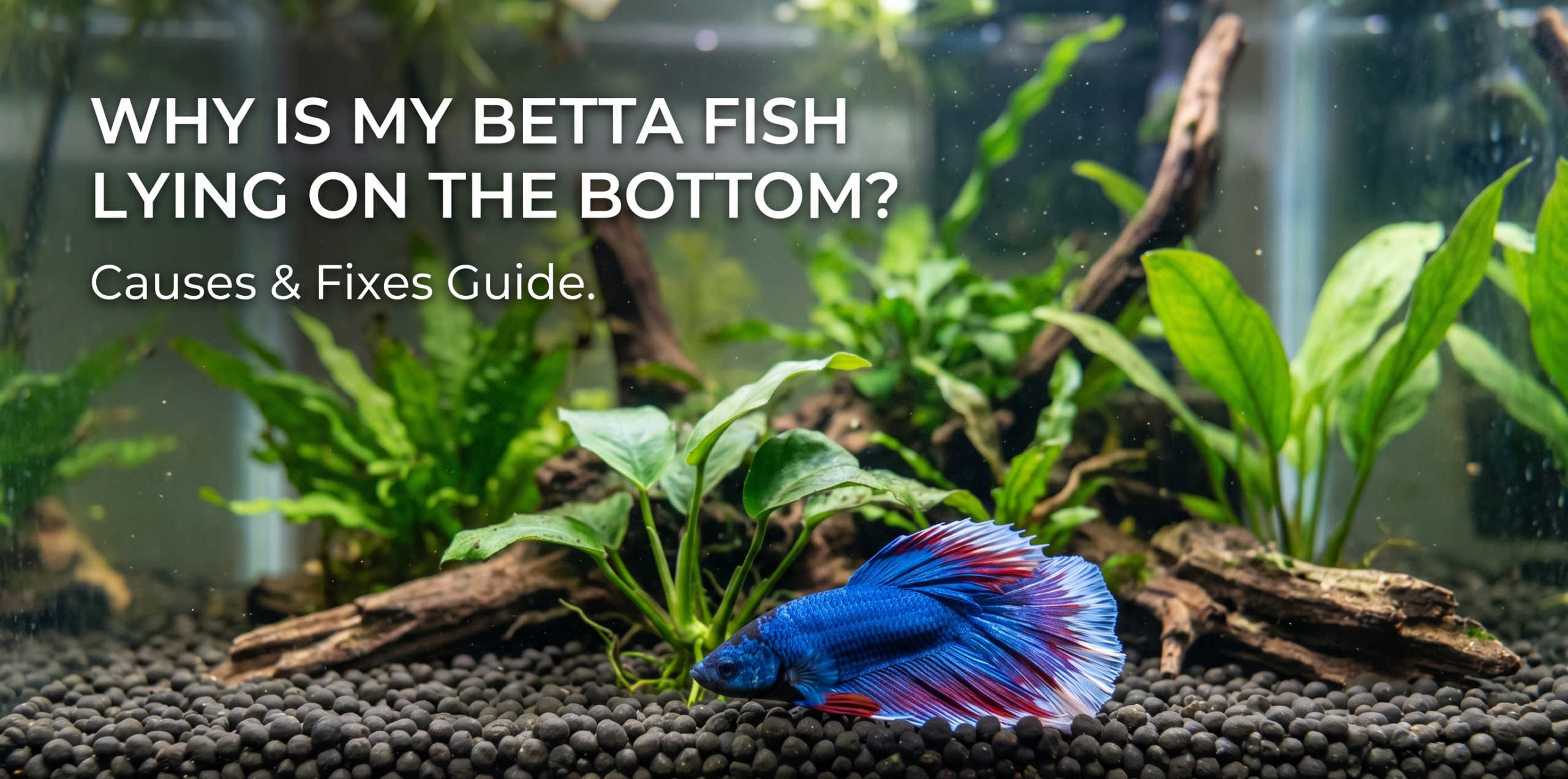
If your betta fish is lying on the bottom of the tank, the first thing to check is whether it’s still breathing. Watch for gill movement. If the gills are moving and your fish occasionally shifts position, it may simply be resting.
Bettas do rest on the substrate, leaves, or decorations. But if it’s motionless, belly-up, or struggling to swim upright, something is wrong and needs your attention now.
1. Swim Bladder Disorder
This is the most common medical reason bettas sink to the bottom or float awkwardly. The swim bladder is an internal organ that controls buoyancy. When it malfunctions, the fish loses control of its position in the water.
Signs:
- Curved or bent body.
- Floating sideways or upside down.
- Sinking despite trying to swim up.
- Bloated belly or pinecone-like scales (in severe cases).
Causes of swim bladder disorder:
- Overfeeding or constipation (most common).
- Bacterial infection.
- Physical injury from rough handling or decor.
- Congenital disability
What to do: Fast your betta for 2–3 days. This alone resolves most cases caused by constipation. After fasting, feed a small piece of a cooked, peeled pea; the fiber helps clear blockages. If the fish doesn’t improve within a week, a bacterial infection may be involved, and you’ll need to treat with an antibiotic like kanamycin or erythromycin.
2. Poor Water Quality
Bettas are sensitive to ammonia, nitrite, nitrate, and pH swings. When water quality drops, your betta will often sit at the bottom, become lethargic, or lose color. This is one of the most preventable causes.
Test your water immediately for:
- Ammonia (should be 0 ppm).
- Nitrite (should be 0 ppm).
- Nitrate (should be under 20 ppm).
- pH (ideal range: 6.5–7.5).
- Temperature (ideal: 76–82°F / 24–28°C).
Fixes:
- Do a 25–50% water change using dechlorinated water.
- Make sure your tank is properly cycled (nitrogen cycle established).
- Don’t overfeed — uneaten food spikes ammonia fast.
- Check that your filter is working correctly.
A 5-gallon tank minimum is recommended for a single betta. Smaller tanks crash faster chemically, and temperature swings are more extreme.
3. Temperature Shock or Cold Water
Bettas are tropical fish. If your tank water drops below 74°F (23°C), your betta will become sluggish, move slowly, and lie at the bottom. This is a direct physiological response — cold slows their metabolism and immune system.
Signs of temperature stress:
- Barely moving.
- Clamped fins.
- Loss of color.
- Sitting near the bottom in the warmest spot.
Fix: Install an aquarium heater rated for your tank size. Aim for a stable 78–80°F. Avoid placing the tank near windows, air conditioning vents, or drafts that cause temperature fluctuations throughout the day.
4. Velvet or Parasitic Infection
Velvet is a parasitic disease caused by Oodinium and is one of the deadliest betta illnesses. It’s often missed because the gold or rust-colored dusting on the fish is nearly invisible without a flashlight.
Signs:
- Lying on the bottom.
- Rubbing against surfaces (flashing).
- Rapid gill movement.
- Gold or rust dust is visible under a flashlight on the body.
- Clamped fins, lethargy.
Treatment: Use a copper-based medication like Copper Safe or a product containing fenbendazole. Dim the tank lights. Velvet parasites need light to complete part of their life cycle. Do not delay treatment; velvet kills quickly.
5. Dropsy
Dropsy is not a disease itself — it’s a symptom of kidney failure or severe internal bacterial infection. It causes fluid retention and is recognized by extreme bloating and scales that stick out like a pinecone.
Signs:
- Severely bloated body.
- Raised/protruding scales.
- Lying at the bottom, unable to move much.
- Pale or discolored gills.
- Eyes may bulge (popeye).
Reality check: Dropsy has a low survival rate, especially when caught late. Treatment involves antibiotics (kanamycin is commonly recommended), Epsom salt baths to reduce swelling, and immediate isolation. If the fish is already in advanced stages, humane euthanasia may be the kindest option.
6. Ammonia Poisoning
If your tank isn’t cycled, ammonia builds up rapidly and burns the betta’s gills and skin. New tanks are especially risky — this is called “new tank syndrome.”
Signs:
- Gasping at the surface or lying at the bottom.
- Red or inflamed gills.
- Red streaks on fins or body.
- Lethargy.
Fix: Do an immediate 50% water change. Add a dechlorinator that detoxifies ammonia temporarily (like Seachem Prime). Test the water every day until the ammonia reads 0. If you haven’t cycled the tank, begin the nitrogen cycle process or use bottled beneficial bacteria to speed it up.
7. Overfeeding and Constipation
Bettas have a stomach roughly the size of their eye. Overfeeding is extremely common and leads directly to constipation, which then causes swim bladder issues and lethargy.
Signs of constipation:
- Bloated belly.
- No bowel movements (watch for little stringy waste).
- Sitting at the bottom, not interested in food.
- Pinecone scaling in severe cases.
Fix: Fast for 2–3 days. Offer a single small frozen daphnia after fasting, as daphnia acts as a natural laxative for fish. Feed your betta once or twice daily with only what it can consume in under 2 minutes, and remove uneaten food immediately.
8. Betta Simply Resting
Not every betta lying on the bottom is sick. Bettas sleep and rest, and they do it in unusual positions — including lying flat on the substrate, on a leaf hammock, or wedged behind a decoration.
How to tell if your betta is resting:
- Gills are moving regularly.
- Color is still vibrant.
- Reacts when you approach the tank or turn on a light.
- Resumes normal activity after a few minutes.
- Eating normally.
Bettas are also most active during daylight hours. If you check at night or early morning, finding them still at the bottom is completely normal.
9. Aging
Older bettas (typically 2 years and beyond, since most bettas are already 6–12 months old when sold) naturally slow down. An aging betta will spend more time resting, eat less, and be less reactive.
Signs of natural aging:
- Faded or duller color.
- Reduced fin spread.
- Slower movement.
- More time resting near the bottom or on leaves.
- No obvious signs of disease.
There’s no treatment for aging. Provide clean water, a stress-free environment, and high-quality food. A betta living to age 3–5 with good care is doing well.
10. Stress and Environmental Issues
Stress suppresses a betta’s immune system and causes behavioral changes, including hiding, lying still, and refusing food.
Common stress triggers:
- Tank too small (under 5 gallons).
- Aggressive tank mates or fin nippers.
- Seeing its own reflection constantly.
- Loud environment or constant vibration near the tank.
- Bright lights with no shaded areas.
- Recent move or tank rearrangement.
- Poor water conditions.
Fix: Identify and remove the stressor. Add plants, especially floating plants or a leaf hammock, to give the betta places to hide and rest. Avoid putting bettas with fin-nipping species like tiger barbs or nippy tetras.
Quick Diagnostic Checklist
If your betta is lying on the bottom right now, run through this list:
- Check water temperature — is it between 76–82°F?
- Test ammonia, nitrite, nitrate, and pH
- Look at the body — any bloating, raised scales, visible spots, or dust?
- Watch the gills — are they moving normally?
- Check fins — are they clamped, torn, or discolored?
- When did the fish last eat?
- Has anything changed recently — new fish, water change, or moved tank?
Your answers will point directly to the cause.
When to Act Immediately?
Take action right away if you see:
- Gill covers are not moving or are moving very fast.
- Belly pointing upward.
- White or gold dust on the body.
- Extreme bloating with raised scales.
- Red streaks anywhere on the body or fins.
- Complete unresponsiveness.
These are medical emergencies. Start with a water change, isolate the fish in a clean hospital tank if possible, and identify the illness to begin appropriate treatment.
Final Thoughts
A betta fish lying on the bottom is either resting or signaling a problem and telling the difference comes down to observation and water testing. Most cases are caused by water quality, temperature, or overfeeding, which are all fixable quickly. Diseases like velvet, dropsy, or bacterial infections require medication and fast action.
Test your water first, always. Most betta health problems trace back to water conditions. Keep the tank cycled, heated, and clean, and your betta will give you the active, vibrant behavior it’s known for.
