
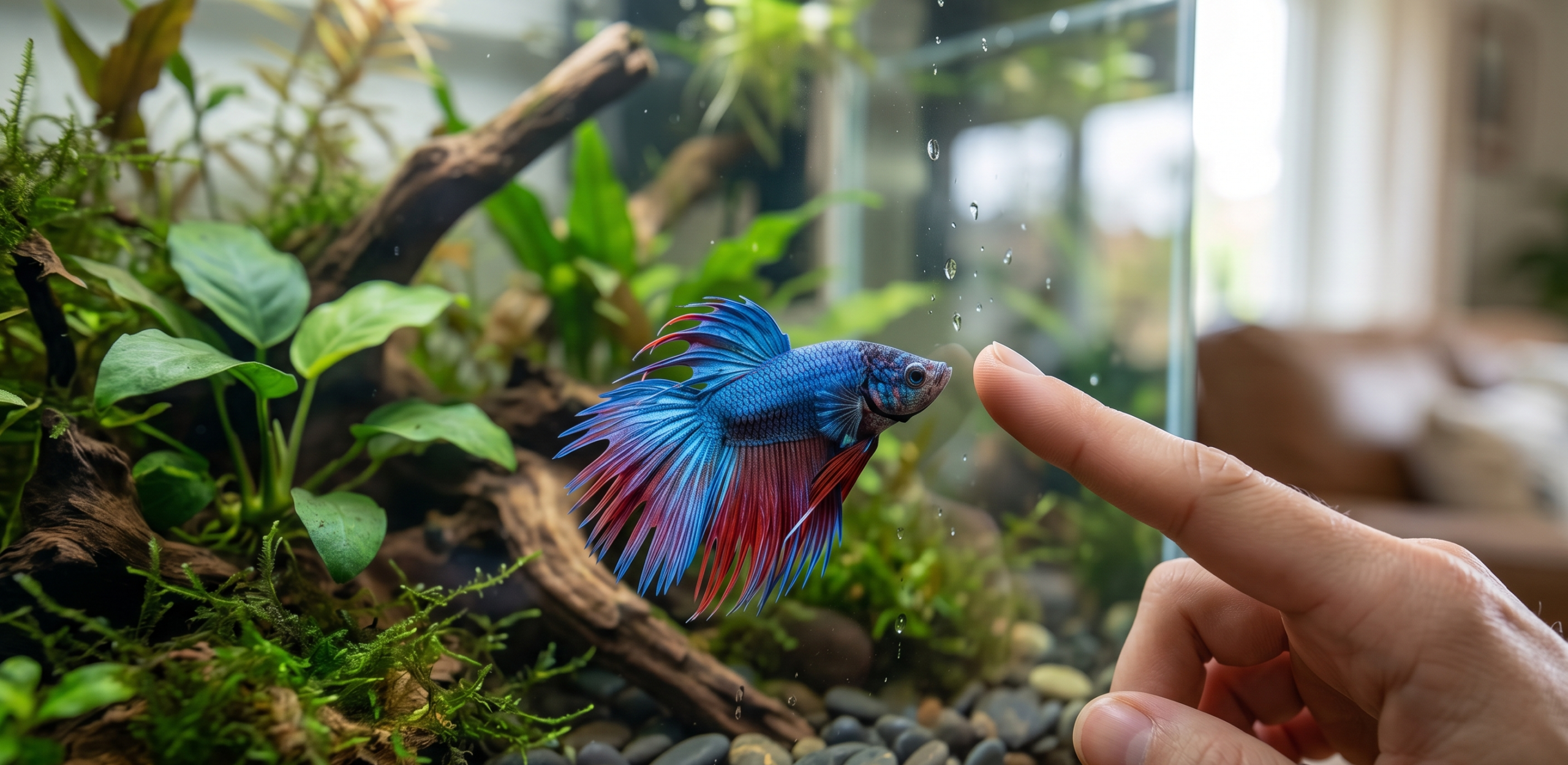
Your betta fish tracks your every move across the tank, eyes locked on you, swimming side to side as you walk past. You’re not imagining it. Betta fish genuinely follow their owners, and there are specific biological and behavioral reasons behind it.
Betta Fish Are Smarter Than Most People Think
Bettas are not passive Fish. They have strong territorial instincts, sharp eyesight, and the capacity to recognize individual humans. Research into fish cognition, including studies published by the Journal of Fish Biology, confirms that Fish can learn, remember, and distinguish between familiar and unfamiliar stimuli.
Your betta can see you clearly through the glass. They identify your shape, your movement, and, over time, your face. That recognition is the foundation of the following behavior.
5 Reasons Your Betta Fish Follows You
1. They Associate You With Food
This is the most common driver. Every time you approach the tank, your betta has learned that food often follows. This is classic conditioned behavior — the same mechanism Ivan Pavlov documented in dogs. Your presence becomes a reliable signal for feeding time.
If your betta follows you most actively right before meals or when you enter the room in the morning, hunger association is almost certainly the cause. This is healthy and normal.
What to watch for: If your betta frantically follows you and begs constantly even after feeding, check that you’re feeding the right portion size — bettas should be fed once or twice a day, with only what they can eat in two minutes.
2. They Recognize You Specifically
Bettas have been shown to distinguish between different humans. A 2021 study from the University of Oxford demonstrated that archerfish, a close relative in behavioral complexity, could tell human faces apart with over 80% accuracy. Betta behavior suggests similar recognition ability.
Your betta follows you specifically, not everyone who walks by. If you’ve noticed your Fish reacts differently to you versus a stranger approaching the tank, this recognition is the reason. The more time you spend near the tank, the stronger this association becomes.
3. Curiosity and Enrichment-Seeking
Bettas are curious Fish. In the wild, they live in rice paddies and slow-moving streams in Thailand and Southeast Asia — environments with constant visual change, insects landing on the surface, and movement above. Movement outside the tank mimics the kind of stimulation they’re wired to pay attention to.
Following you may be your betta engaging with their environment. It’s a sign of an active, alert fish — not a distressed one.
If your betta lacks enrichment inside the tank, external movement becomes more appealing. Adding plants, caves, and resting spots can reduce over-dependence on watching you, though some following behavior will always remain.
4. Territorial Display or Warning Behavior
Not all followers are friendly. If your betta flares their gills, spreads their fins wide, or turns sideways while tracking you, they may be displaying territorial aggression. They see your reflection or your large silhouette as a potential intruder.
This is more common in male bettas. It’s instinctive — in the wild, bettas defend their space aggressively. The glass tank creates a situation where the “threat” never leaves, which can cause chronic stress if the Fish is constantly flaring.
Signs this might be the issue:
- Consistent gill flaring at you or their own reflection
- Clamped fins between flares
- Loss of appetite despite following behavior
- Pale or darkened coloration
If you suspect stress-driven following, reduce reflections in the tank by adjusting lighting and add more cover with plants or decorations.
5. Genuine Bonding
Some betta owners dismiss this, but the evidence supports it. Bettas kept in enriched environments with regular human interaction show calm, approach-based following rather than stress-based responses. They swim toward the glass when you approach, track you without flaring, and often come to the surface near your hand.
This is bonding behavior. It’s comparable — on a simpler neurological scale — to how a cat watches you from a windowsill. They’re not in distress. They’re oriented toward something familiar and safe.
According to fishkeeping research compiled by the ASPCA, Fish kept in stimulating environments with consistent owner interaction show lower stress hormones and longer lifespans. Interaction matters.
How to Tell If the Following Behavior Is Healthy or Stressed?
This is the key question most betta owners need to answer.
Healthy following looks like:
- Smooth, relaxed swimming toward you
- Fins open and flow naturally
- The fish comes to the surface near your hand
- Bright, vivid coloration
- Normal feeding behavior
Stress-related symptoms look like:
- Constant gill flaring at the glass
- Darting, erratic movements
- Fins clamped tight
- Fish refuses food despite following you
- Faded color or white stress bars (horizontal lines on the body)
If you see stress signs, evaluate the tank setup. The leading causes of betta stress are water temperature outside the 76–82°F (24–28°C) range, ammonia or nitrite spikes from poor filtration, an undersized tank (bettas need a minimum of 5 gallons), and excessive reflections that create phantom rivals.
The Aquarium Science organization provides detailed water chemistry guides specifically relevant to betta care.
Does My Betta Actually Know Who I Am?
Yes — with nuance. Your betta doesn’t know your name or understand you as a person. What they do know is your silhouette, your movement pattern, and the consistent outcome of your presence (usually food or interaction). That’s enough to produce reliable recognition behavior.
The more consistently you interact with your betta, the stronger this recognition becomes. Bettas in active households where multiple people approach the tank often follow the primary caregiver more closely than others. That’s not a coincidence — it’s a learned association built over time.
How to Strengthen the Bond With Your Betta?
If you want your betta to follow you more and display less stress-based behavior, these steps work:
Feed by hand or with tongs. Lower your finger or a feeding stick to the surface regularly. This builds trust through positive interaction outside of stress.
Establish a routine. Feed at the same times daily. Consistent patterns reinforce the association between you and positive outcomes.
Talk near the tank. Bettas respond to vibration as much as sight. Your voice creates low-frequency vibrations that they detect through their lateral line — the sensory organ running along their sides. It won’t teach them language, but it adds another layer of familiar stimulation.
Move slowly near the tank. Fast, sudden movements trigger a fear response. Slow, predictable movement signals safety.
Provide a well-designed environment. A betta in a clean, properly heated, adequately sized tank with plants and hides is a betta that follows you out of curiosity — not because the tank is barren and you’re the only thing happening.
Common Questions About Betta Following Behavior
Is it normal for a betta to follow my finger?
Yes. Finger-following is one of the most common interactive behaviors bettas display. It combines food anticipation, curiosity, and recognition. Many owners use finger-following as a starting point for hand training.
Why does my betta follow me but hide from everyone else?
This is direct evidence of individual recognition. Your betta has formed a specific association with you. Other people may move differently, smell differently through the water surface chemistry, or haven’t spent enough time near the tank to register as familiar.
Should I be worried if my betta stares at me constantly?
Only if paired with stress signs like flaring, clamped fins, or color loss. A betta that watches you calmly with open fins and normal color is simply an alert, engaged Fish doing exactly what healthy bettas do.
Final Thoughts
Your betta follows you because you are genuinely significant to them — as a food source, a familiar presence, and over time, a recognized individual. This behavior is one of the more compelling examples of fish intelligence that most people underestimate.
The key takeaway: following behavior combined with bright color, open fins, and normal feeding is a sign of a healthy, bonded betta. The following behavior, paired with flaring, stress bars, or food refusal, points to an environmental issue worth investigating.
Understanding why your betta follows you helps you respond correctly — reinforcing the positive bond rather than accidentally rewarding stress behaviors. The more intentional your interactions, the more your betta’s behavior will reflect a fish that genuinely recognizes and responds to you.
For deeper reading on betta behavior and care, Seriously Fish provides peer-reviewed species data on Betta splendens used by aquarists and researchers alike.
