
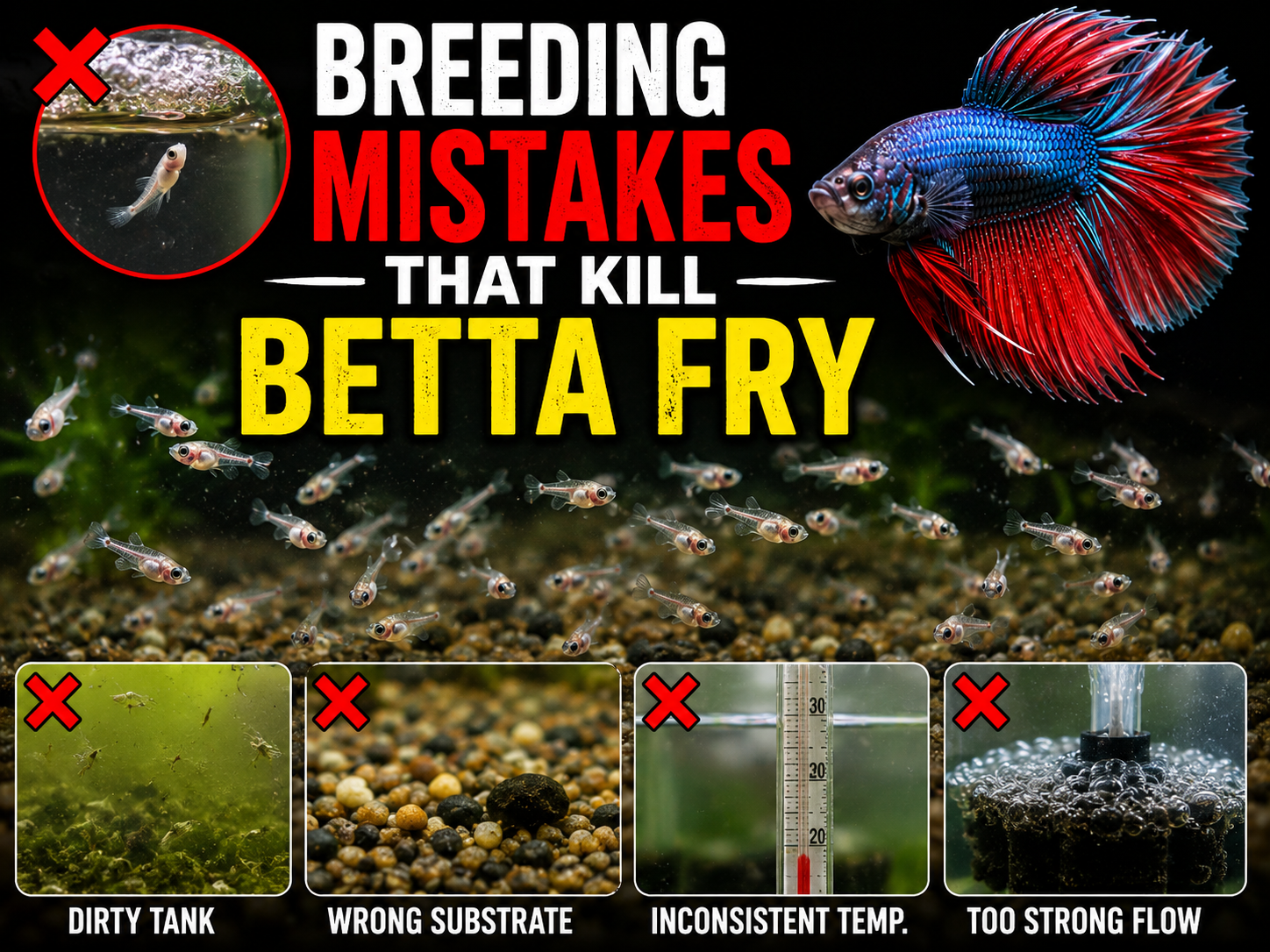
Hatching baby fish brings immense joy to any dedicated aquarist. Watching those tiny newborns drop to the tank floor one by one brings intense frustration. Many keepers encounter breeding mistakes that kill betta fry without ever realizing the underlying cause. Survival rates plummet instantly when specific environmental and dietary needs go unmet.
Fish breeding requires precision, patience, and exact timing. A single degree of temperature shift or a missed meal can decimate a newly hatched spawn. You must recognize these errors before your fish suffer the consequences. We will break down exactly why your baby fish are struggling and how to fix it.
What Are the Most Common Breeding Mistakes That Kill Betta Fry?
If you want to save your newly hatched fish, you must act fast. Here are the fatal errors you need to correct immediately to ensure survival:
- Starvation: Offering food that is physically too large for their tiny mouths to consume.
- Overfeeding: Rotting food causes massive ammonia spikes in small rearing tanks.
- Temperature Shock: Allowing the water to cool down or fluctuate heavily overnight.
- Draft Exposure: Leaving the top of the tank uncovered causes fatal damage to developing labyrinth organs.
- Predation: Leaving the adult male fish in the rearing tank after the babies become free-swimming.
- Filter Suction: Using power filters that create strong currents and suck up weak swimmers.
- Toxic Water: Failing to perform small, daily water changes to remove invisible waste buildups.
Mistake 1: Ruining the Feeding Schedule and Sizing
Feeding newly hatched fish is the most difficult part of the entire process. Their mouths are microscopic during the first week of life. If you drop standard commercial flakes into the water, they will starve. They cannot process or digest commercial dry foods.
Feeding Too Early
Many new breeders panic and dump food into the water the moment the eggs hatch. This is a massive error. Newly hatched fry survive off their nutrient-rich yolk sacs for the first 48 to 72 hours. They hang vertically from the bubble nest and do not need any external food.
Adding food during this yolk-sac phase only poisons the water. The uneaten food rots on the bare bottom of the glass. This creates a deadly bacterial bloom that suffocates the delicate newborns. Wait until they swim horizontally on their own before offering their first meal.
Offering the Wrong Food Size
Once they swim horizontally, they need live, microscopic prey. A common error is offering baby brine shrimp on day one. Baby brine shrimp are far too large for a three-day-old newborn to swallow. You must start with smaller organisms.
Provide infusoria or vinegar eels for the first five days of free-swimming life. Infusoria are single-celled organisms that perfectly fit inside a newborn’s mouth. You can culture these at home using vegetable matter and aquarium water. Refer to resources on zooplankton cultivation from FishBase to understand aquatic microdiets.
Transitioning Foods Improperly
Around day seven, you can transition them to freshly hatched baby brine shrimp. The mistake here is abruptly stopping the infusoria. Some slower-growing babies will still need the microscopic food. Always overlap your food types for a few days to ensure the runts do not starve.
Feed them tiny amounts three to four times a day. Their stomachs are roughly the size of their eyeballs. Dump too much in, and the leftovers will quickly destroy your water chemistry.
Mistake 2: Failing to Maintain Pristine Water Quality
Clean water is the absolute foundation of healthy fish growth. Rearing tanks are usually small, heavily fed, and lack strong filtration. This creates a dangerous environment where toxins accumulate rapidly.
The Danger of Invisible Ammonia Spikes
Ammonia is a silent killer in the aquarium hobby. Fish waste and uneaten food break down into ammonia within hours. Because you are feeding live foods multiple times a day, ammonia levels skyrocket quickly. Fry has zero tolerance for even trace amounts of this chemical.
Symptoms of ammonia poisoning include clamped fins, lethargy, and sudden death. You cannot see ammonia with the naked eye. You must test your water daily using a liquid test kit. If the reading shows anything above zero, you are actively losing fish.
Performing Improper Water Changes
To combat ammonia, you must remove old water and replace it with fresh water. However, large, sudden water changes shock their delicate systems. Removing 50% of the water at once will often kill the entire spawn. The shock in temperature and pH parameters is too aggressive.
Instead, perform a 10% water change every single day. Use a piece of airline tubing to slowly siphon out waste. The narrow tubing prevents you from accidentally sucking up the tiny fish. It gives you precise control over cleaning bare-bottom glass.
When adding fresh water back in, use the drip method. Tie a loose knot in your airline tubing to slow the flow. Let the fresh, treated water drip into the tank for over an hour. This eliminates parameter shock.
Mistake 3: Getting Temperature and Air Quality Wrong
Fish are ectothermic, meaning their body heat matches the environment. Rapid temperature drops slow their metabolism to a halt. When their metabolism slows, their immune system shuts down, and their digestion halts.
Fluctuating Water Temperatures
A rearing tank requires a steady, unwavering temperature of 80°F to 82°F (27°C – 28°C). Any fluctuation greater than two degrees can induce fatal stress. Small tanks lose heat incredibly fast in cool rooms. A high-quality adjustable heater is absolutely mandatory.
Never place the rearing setup near windows, air conditioning vents, or drafty hallways. The ambient room temperature will fight the heater, causing cold spots in the water. Babies resting in these cold spots will develop swim bladder issues. They will slide along their bellies rather than swim normally.
Ignoring the Labyrinth Organ Phase
Around three to five weeks of age, a critical biological shift happens. The fish begin to develop their labyrinth organ. According to research on anabantoid biology, this organ allows them to breathe atmospheric air from the surface.
During this development phase, the air above the water must match the water temperature perfectly. If they gulp cold, dry room air, it damages the developing organ. This causes immediate respiratory failure and death.
To prevent this, keep a tight-fitting lid or plastic wrap on the tank. This traps humidity and heat. Leave a small gap for fresh oxygen exchange, but keep the space heavily sealed. Do not remove the lid entirely until they are at least two months old.
Mistake 4: Leaving the Male in the Tank Too Long
The adult male plays a vital role in the early stages of life. He builds the bubble nest, catches falling eggs, and protects the hatchlings. He will diligently pick up sinking newborns and spit them back into the bubbles. He is a great father, but only for a very specific window of time.
Once the babies become free-swimming, his parental instincts shut off entirely. The horizontal swimming motion triggers his predatory drive. If you leave him in the tank, he will view his offspring as a live food source. He will hunt down and consume the entire spawn within a few hours.
Remove the male the moment you see most of the babies swimming horizontally. Carefully scoop him out with a soft net and return him to his isolated enclosure. Do not feel bad for separating them; you are saving their lives.
Mistake 5: Using the Wrong Filtration System
Filtration keeps the nitrogen cycle stable, but it can also be a death trap. Standard hang-on-back power filters create massive currents. Newborns are incredibly weak swimmers and cannot fight heavy water flow.
The Power Filter Death Trap
If you run a power filter, the intake tube acts like a vacuum. It will instantly suck the tiny fish into the motor impeller. Even if you cover the intake with a sponge, the water current will exhaust them. They will burn all their calories fighting the flow and eventually starve.
The Only Safe Filter Option
You must use a seasoned, gentle sponge filter powered by an air pump. A sponge filter provides excellent biological filtration without creating a dangerous vortex. It pulls water gently through a porous foam block.
To make it even safer, attach a flow-control valve to your airline tubing. Dial the air pressure down until the filter produces a slow, steady stream of bubbles. The babies can safely graze on the microscopic organisms that grow on the sponge surface.
Mistake 6: Adding Decor and Substrate
A beautifully aquascaped tank looks great in your living room. However, it is a nightmare for raising newly hatched fish. Gravel, sand, and heavy decorations create massive problems for the breeder.
The Bare Bottom Rule
Rearing tanks must have bare glass bottoms. Gravel creates deep crevices where uneaten food and dead fish disappear. You cannot siphon waste out of gravel without crushing the survivors in the process. The rotting waste trapped in the rocks will silently crash your water parameters.
A bare bottom allows you to see every speck of dirt immediately. You can pinpoint exactly how much food is being ignored. You can also spot dead babies quickly and remove them before they decompose.
Limited Hiding Spots
While you should avoid heavy decor, you still need to provide mild cover. Floating plants like Hornwort or Water Sprite are excellent additions. They provide resting spots near the surface and harbor edible microorganisms.
Avoid plastic plants entirely. Plastic edges easily tear the developing fins of young fish. Stick to simple, live floating greenery that requires zero maintenance.
Mistake 7: Ignoring Belly Sliders
Belly sliders are babies that drag themselves across the bottom glass. They appear heavy and struggle to reach the surface to breathe. This is a severe developmental issue caused by an inflamed swim bladder.
This condition stems from three specific errors. The first is feeding heavily without cleaning the bottom, which can cause bacterial infections in the gut. The second is growing them in water that is entirely too shallow. The third is severe temperature drops that stop their digestive tracts from processing heavy proteins.
If you spot belly sliders, you must act quickly. Isolate them in a shallow, warm container with pristine water. Stop feeding them heavy proteins for a day to allow their digestive systems to clear out. Unfortunately, severe cases rarely recover, which proves why prevention is so critical.
How to Prevent Betta Fry Deaths (Step-by-Step Guide)
You now know the pitfalls. Follow this exact timeline to ensure the highest survival rates in your breeding setups.
- Days 1-3: Keep the temperature locked at 81°F. Leave the male in the tank to tend the nest. Do not feed anything at all.
- Day 4: Watch for horizontal swimming. Once they detach from the nest, remove the adult male immediately. Add the first drops of infusoria.
- Days 5-10: Feed infusoria three times a day. Begin siphoning the bottom glass with a rigid airline tube. Drip fresh, heated water back into to replace the removed volume.
- Days 11-14: Start adding freshly hatched baby brine shrimp alongside the infusoria. Keep the tank tightly covered with plastic wrap to maintain high humidity.
- Weeks 3-5: This is the stage of labyrinth organ development. Do not let cold air touch the water surface. Continue daily 10% water changes. Transition slowly to micro-worms or finely crushed high-protein pellets.
- Weeks 6-8: The survivors will begin showing aggressive tendencies. You must start separating the largest males into their own heated jars. Maintain high water quality to promote rapid fin growth.
Conclusion
Raising baby fish demands extreme attention to detail and a strict daily routine. You can trace nearly every single disaster back to water chemistry, temperature control, or feeding habits. When you understand the biology of these tiny animals, raising them becomes a predictable science.
Focus heavily on culturing the right microscopic foods before the eggs even hatch. Invest in a reliable adjustable heater, and commit to slow, daily maintenance. Keep the male away from his free-swimming kids, and tightly seal the lid to protect their developing lungs.
