
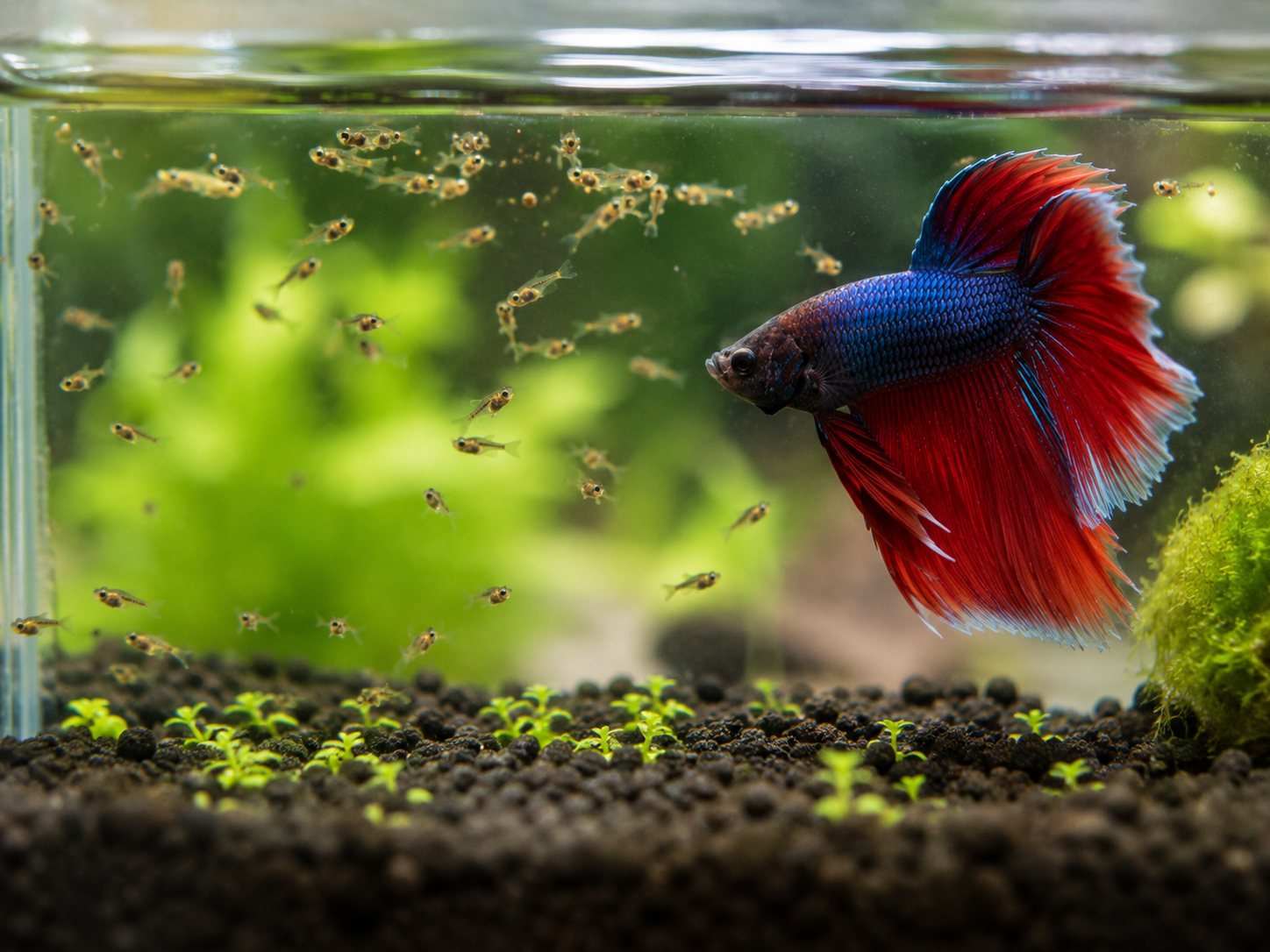
Successful betta breeding requires strict water management and the use of microscopic live foods. You must prepare your nursery tank and food cultures at least 2 weeks before the eggs hatch. Knowing exactly how to raise betta fry without losing most of them comes down to preparation.
Newborn bettas are incredibly fragile and cannot consume standard fish food. They rely entirely on their yolk sacs for the first few days. After that, they need moving, microscopic prey to trigger their hunting instincts.
Maintaining pristine water conditions without creating strong currents is your biggest challenge. A single ammonia spike or temperature drop can wipe out an entire spawn overnight.
What is the Survival Rate of Betta Fry?
- Average Survival: Breeders typically see a 70% to 80% survival rate under optimal conditions.
- Poor Conditions: Unprepared tanks often result in survival rates of 10% or less.
- Main Causes of Death: Starvation, poor water quality, and temperature fluctuations.
- Optimal Yield: A healthy spawn can produce 50 to over 100 surviving adult bettas.
Preparing the Fry Tank: Setup and Water Parameters
You cannot keep newborn bettas in a standard community aquarium. They require a specialized nursery environment, often called a grow-out tank. Set this tank up alongside your breeding tank.
Ideal Tank Size and Layout
Start with a bare-bottom 10-gallon aquarium. Do not add gravel or sand to the bottom. A bare floor makes it easy to spot dead fry and siphon out uneaten food.
Add live plants, such as Java Moss or Indian Fern. These plants provide hiding spots and harbor natural microscopic organisms for the fry to eat. Keep the water level shallow, around five inches deep, during the first week. Shallow water helps the fry reach the surface to develop their labyrinth organ.
Heating and Filtration Needs
Maintain a steady water temperature between 80°F and 82°F (26°C-28°C). Use an adjustable submersible heater placed horizontally near the tank floor. Fluctuating temperatures suppress the immune systems of the young fish.
Standard power filters will suck up and kill tiny fry. You must use a gentle sponge filter connected to an air pump. Adjust the airflow valve so the bubbles release very slowly. This provides biological filtration without creating a dangerous current.
What to Feed Betta Fry From Hatching to Adulthood?
Feeding is the most critical factor in fry survival. If the food does not move, the fry will not eat it. You must culture live foods at home.
Days 1 to 3: The Yolk Sac Phase
When betta eggs first hatch, the fry hang vertically from the bubble nest. They look like tiny slivers of glass with a dark bulge on their bellies. This bulge is their yolk sac.
Do not feed them during this period. They absorb the yolk sac for their initial nutrients. The male betta will continuously catch falling fry and spit them back into the nest. Leave the male in the tank to perform this duty.
Days 4 to 14: Infusoria and Vinegar Eels
Once the fry swim horizontally, remove the adult male immediately. The fry have depleted their yolk sacs and are now starving. You must feed them microscopic foods like infusoria.
Infusoria are single-celled organisms cultivated by soaking vegetable matter in water. Feed the fry small squirts of infusoria water using a medicine dropper three times a day. You can also feed them vinegar eels, tiny nematodes that thrive in fresh water.
Weeks 2 to 4: Baby Brine Shrimp and Micro Worms
Around the two-week mark, the fry double in size. They now need larger, protein-rich live foods to fuel their growth. Newly hatched baby brine shrimp (BBS) are the gold standard for this stage.
You must hatch the brine shrimp cysts in a separate, aerated saltwater container. Rinse the hatched shrimp in fresh water before feeding them to your bettas. Micro worms are another excellent, easily cultured food source during this phase. Alternate between BBS and micro worms to provide a balanced diet.
Weeks 4+: Transitioning to Dry Foods
By week four, the fry resemble miniature adult bettas. You can begin introducing crushed, high-protein dry foods. Start with powdered fry food or finely crushed betta pellets.
Mix a tiny amount of the dry food with their live food. They will accidentally consume the dry particles while hunting the live prey. Gradually reduce the live food over several weeks until they accept pellets entirely.
Maintaining Pristine Water Quality
Heavy feeding schedules quickly pollute the tank water. Ammonia and nitrite spikes are fatal to young bettas. You must establish a strict cleaning routine.
How to Perform Safe Water Changes?
Begin small water changes when the fry are one week old. Siphon out 10% of the water using a piece of standard airline tubing. Airline tubing is narrow enough to avoid sucking up the tiny fish.
Increase the water change volume to 20% by week three. Always replace the removed water with conditioned water that matches the exact temperature of the tank. Use a drip acclimation method to introduce the new water slowly. Sudden shifts in chemistry will shock their delicate systems. Read more about proper water conditioning guidelines from trusted veterinary sources.
Removing Dead Fry and Uneaten Food
Inspect the bare tank floor twice a day. Use a turkey baster to suck up any dead fry gently. Decaying bodies create massive ammonia spikes.
Remove uneaten brine shrimp or micro worms after twenty minutes. Snails can serve as an excellent cleanup crew in a grow-out tank. Add a few Ramshorn or pond snails to consume leftover debris.
Developing the Labyrinth Organ
Bettas are anabantoids, meaning they breathe atmospheric air. They develop a specialized labyrinth organ around three to six weeks of age. This is a highly sensitive developmental period.
Keep a tight-fitting lid or glass canopy on the tank. The air above the water must remain warm and humid. If the fry breathe cool, dry air during this stage, they will develop fatal respiratory issues. Maintain the water temperature and the ambient air temperature at a consistent 80°F.
Identifying and Preventing Common Fry Diseases
Disease spreads rapidly in a crowded grow-out tank. Prevention is entirely dependent on your water change schedule. Watch closely for behavioral changes.
Velvet Disease (Oodinium)
Velvet is a common parasite that attacks young bettas. Infected fry clamp their fins, scrape against objects, and look like they are dusted with gold powder. Velvet thrives in dark, poorly maintained tanks.
Keep the tank well-lit during the day to deter the parasite. If an outbreak occurs, slowly raise the temperature to 84°F. You will need to treat the tank with a copper-based medication formulated for sensitive fish.
Swim Bladder Issues
Some fry will develop swollen bellies and struggle to swim upright. They may slide across the tank floor or float uncontrollably at the surface. This is a swim bladder disorder, often caused by overfeeding.
Stop feeding them for 24 hours. Ensure you do not feed unhatched brine shrimp cysts, as they can cause severe blockages. Maintain pristine water, and the issue often resolves itself within a day.
The Jarring Process: When to Separate Male Betta Fry
Around eight to ten weeks of age, male bettas begin showing aggressive tendencies. They will flare at their siblings and nip fins. You must separate the aggressive males to prevent injuries and death.
This process is known as “jarring” in the hobby. Prepare individual containers, such as large mason jars or separate small tanks. Fill these containers with water taken directly from the grow-out tank to prevent shock.
Place the jars near each other, but use opaque cards between them. Removing visual contact stops them from constantly flaring and stressing themselves out. Change 50% of the water in these individual jars every two days.
Females can usually remain together in the larger tank. This forms a “sorority” setup. Keep a close eye on the females, as some dominant individuals may still exhibit aggression and need to be removed.
Summary Checklist for Maximum Yield
Follow this timeline checklist to ensure your breeding project stays on track. Missing a single step often results in total spawn loss.
- Pre-Spawn: Culture infusoria and set up a bare-bottom 10-gallon tank.
- Day 1-3: Do not feed. Leave the adult male in the tank.
- Day 4: Remove the male. Begin feeding infusoria.
- Day 7: Start 10% daily water changes using airline tubing.
- Day 14: Introduce baby brine shrimp and micro worms.
- Week 4: Begin mixing in powdered dry foods. Cover the tank tightly.
- Week 8: Watch for aggression and prepare to jar the males.
Breeding these fish requires immense patience and daily dedication. By closely monitoring water parameters and cultivating live microscopic foods, you avoid the common pitfalls of novice breeders. Understanding how to raise betta fry without losing most of them ensures a thriving, healthy generation of beautiful fish.
