
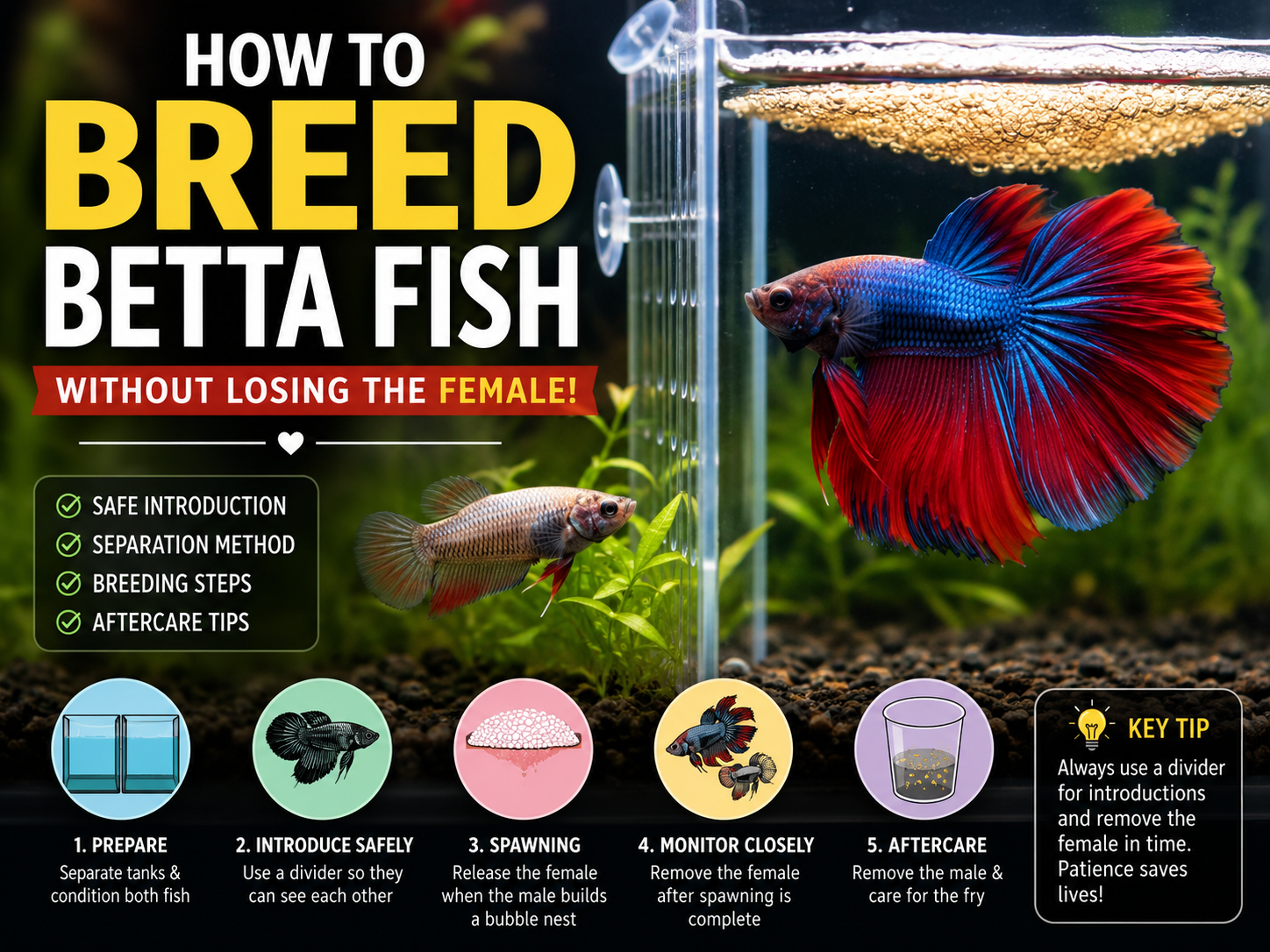
Learning how to breed betta fish without losing the female requires precise timing, proper tank setup, and close observation. Siamese fighting fish are highly territorial. If you leave the female in the tank too long after spawning, the male will attack her to protect his nest.
To keep your fish safe, you must condition both partners thoroughly beforehand. You must also provide adequate hiding spaces in the breeding environment. Most importantly, you must remove the female immediately after she finishes releasing her eggs.
Why Do Male Betta Fish Attack Females?
Understanding betta behavior is crucial for successful breeding. Male bettas build bubble nests and act as the sole caretakers for the eggs. During the reproductive cycle, the male’s instincts shift entirely to guarding his nest.
The female becomes an immediate threat to the brood the moment spawning concludes. She is exhausted and hungry, and she will often attempt to eat the newly laid eggs. The male instinctively chases her away with lethal force. He will cause severe fin damage or death if she remains trapped in a small space.
Setting Up the Ideal Breeding Tank
A proper environment drastically reduces aggression. Do not use a standard display aquarium for reproduction. Set up a dedicated bare-bottom tank to ensure the safety of both fish. A 10-gallon tank provides enough room for the female to flee if the male becomes too aggressive.
Tank Size and Water Parameters
Strict water parameters keep the fish healthy and encourage spawning. Use a reliable liquid test kit to monitor your water daily.
- Tank Size: 10 gallons minimum.
- Water Depth: Fill the tank to only 5 or 6 inches deep. Shallow water makes it easier for the male to retrieve sinking eggs.
- Temperature: Maintain a steady 80°F to 82°F using an adjustable heater.
- pH Level: Aim for a slightly acidic pH between 6.5 and 7.0.
- Filtration: Use a gentle sponge filter. Strong currents will destroy the bubble nest.
Hiding Spots and Tannins
Hiding spots are mandatory for the female’s survival. If the male becomes too violent before she is ready to mate, she needs places to break his line of sight.
- Add dense clusters of live plants, such as Java Moss or Guppy Grass.
- Place clean PVC pipes or terracotta pots on the bottom.
- Introduce Indian Almond leaves to the water. These leaves release tannins that darken the water, lower the pH, and mimic their natural habitat.
- According to research published by the Journal of the World Aquaculture Society, tannins possess mild antibacterial properties that help heal torn fins and protect eggs from fungus.
Selecting and Conditioning the Breeding Pair
Never breed unhealthy or genetically weak fish. Choose fish that are between 4 and 12 months old. At this age, they are most fertile and energetic.
Diet Requirements
Conditioning prepares the fish physically for the grueling mating process. You must feed them a high-protein diet for 2 weeks before introduction. Stop feeding them dry pellets during this phase.
- Feed live or frozen bloodworms twice daily.
- Offer live brine shrimp or daphnia to trigger hunting instincts.
- Provide mosquito larvae if available in your area, safely.
- Feed small portions to avoid bloating. Clean any uneaten food immediately to prevent ammonia spikes.
The Visual Introduction Phase
Never drop a female directly into a male’s territory. This will trigger an immediate fight. You must introduce them slowly so they become accustomed to each other’s presence.
- Place the male in the prepared 10-gallon breeding tank.
- Float the female inside the tank using a clear plastic cup, a chimney, or a tank divider.
- Observe their behavior closely. The male should flare and begin building a bubble nest under the almond leaf or a styrofoam cup cut in half.
- Look for vertical stripes on the female’s body. These breeding stripes indicate she is receptive to his advances.
Step-by-Step Guide: How to Breed Betta Fish Without Losing the Female
Follow these exact steps once the male has built a substantial bubble nest and the female displays vertical stripes.
Step 1: Releasing the Female
Release the female quietly into the main tank. Do this when you have several hours of free time to supervise them. The male will immediately chase her.
This initial aggression is normal behavior. He will nip her fins and drive her into hiding. Do not intervene unless the aggression becomes life-threatening.
Step 2: Monitoring the Courtship
The courtship phase can last anywhere from 12 to 48 hours. The male will continuously herd the female toward his bubble nest. She will inspect the nest to determine if it meets her standards.
If she approves, she will approach him with her head down in a submissive posture. If she destroys the nest or swims away constantly, she is not ready. You must remove her and try conditioning them for another week if this happens.
Step 3: Observing the Nuptial Embrace
When both fish are ready, they will position themselves under the bubble nest. The male will wrap his body tightly around the female. This act is called the nuptial embrace.
The embrace squeezes the eggs out of the female’s body. The male simultaneously fertilizes them in the water column. The female will enter a temporary state of paralysis, floating motionless like a leaf.
Step 4: Egg Retrieval
As the eggs sink, the male will break the embrace and dive after them. He catches the eggs in his mouth, swims to the surface, and spits them safely into the bubbles. The female will wake up from her paralysis and help him retrieve the eggs.
They will repeat this embrace dozens of times over several hours. A successful spawn can yield between 50 and 500 eggs.
Step 5: The Critical Removal Phase
You must act quickly once the spawning process is complete. You will know they are done when the female stops approaching the nest. She will usually hide in the furthest corner of the tank.
The male will violently chase her away from the nest at this point. Use a soft mesh net to scoop her out immediately. Transfer her to a separate, quiet recovery tank. Leave the male alone to tend to the eggs.
Signs You Must Separate the Betta Fish Immediately
Sometimes, the breeding attempt fails. You must know when to abort the mission to save your female’s life. Separate them immediately if you observe any of the following signs.
- Missing scales: A few torn fins are normal, but missing patches of scales indicate severe physical trauma.
- Constant hiding: If the female cowers at the bottom and never attempts to approach the nest after 48 hours, she is terrified.
- Lethargy: If she stops swimming away and lets the male attack her, she is exhausted and near death.
- Horizontal stripes: Horizontal lines indicate extreme stress. Vertical lines indicate breeding readiness.
Treating a Female Betta After Breeding
The female will look battered and exhausted after a successful spawn. Proper post-breeding care prevents secondary infections and ensures a full recovery.
Set up a dark, quiet hospital tank for her. Keep the water pristine with daily 10% water changes. Add a water conditioner containing aloe vera to promote slime coat regeneration.
Treat the water with a mild antifungal and antibacterial medication, such as Methylene Blue. This prevents fin rot from taking hold in her torn fins. Feed her high-quality live foods to replenish her depleted energy reserves.
Essential Equipment Checklist for Safe Spawning
Gather all necessary supplies before you begin. Missing a critical piece of equipment can jeopardize the female’s safety.
- 10-gallon bare-bottom glass aquarium.
- Tight-fitting glass or plastic lid to trap humidity.
- Adjustable 50-watt submersible heater.
- Sponge filter with an adjustable air pump.
- Clear plastic chimney or commercial tank divider.
- Soft, fine-mesh catching net.
- Indian Almond leaves and live floating plants.
- Liquid water testing kit.
- Dedicated 5-gallon recovery tank.
Managing the Male and the Eggs
After you remove the female, the male takes over completely. Keep the tank lights on dimly overnight. If the tank goes completely dark, the male cannot see the eggs that fall from the nest.
He will spend the next 24 to 48 hours constantly picking up fallen eggs and blowing new bubbles. The eggs will hatch into tiny fry with yolk sacs attached to their bellies. The male will continue to catch them and spit them back into the nest until they are swimming freely horizontally.
Once the fry are free-swimming, you must remove the male. If left in the tank, he may eventually view the swimming fry as a food source.
Feeding the New Fry
Once both parents are safely removed, your focus shifts to the babies. Betta fry are microscopic and require specialized microscopic food.
Start by feeding them infusoria or vinegar eels twice a day. After a week, you can transition them to freshly hatched baby brine shrimp. Maintain pristine water conditions, as fry are highly susceptible to ammonia poisoning. For detailed fry nutrition guidelines, consult resources from established veterinary institutions, such as the College of Veterinary Medicine at Cornell University.
Conclusion
Understanding how to breed betta fish without losing the female comes down to preparation and vigilance. You cannot rush this delicate process. By setting up a proper shallow tank with heavy cover, you give the female an essential escape route. Conditioning both fish with live foods ensures they have the stamina to survive the mating ritual.
Always use a divider to introduce them slowly and safely. Watch the spawning embrace closely so you know exactly when the process ends. The moment the male claims sole ownership of the eggs, remove the female immediately to a medicated recovery tank.
