
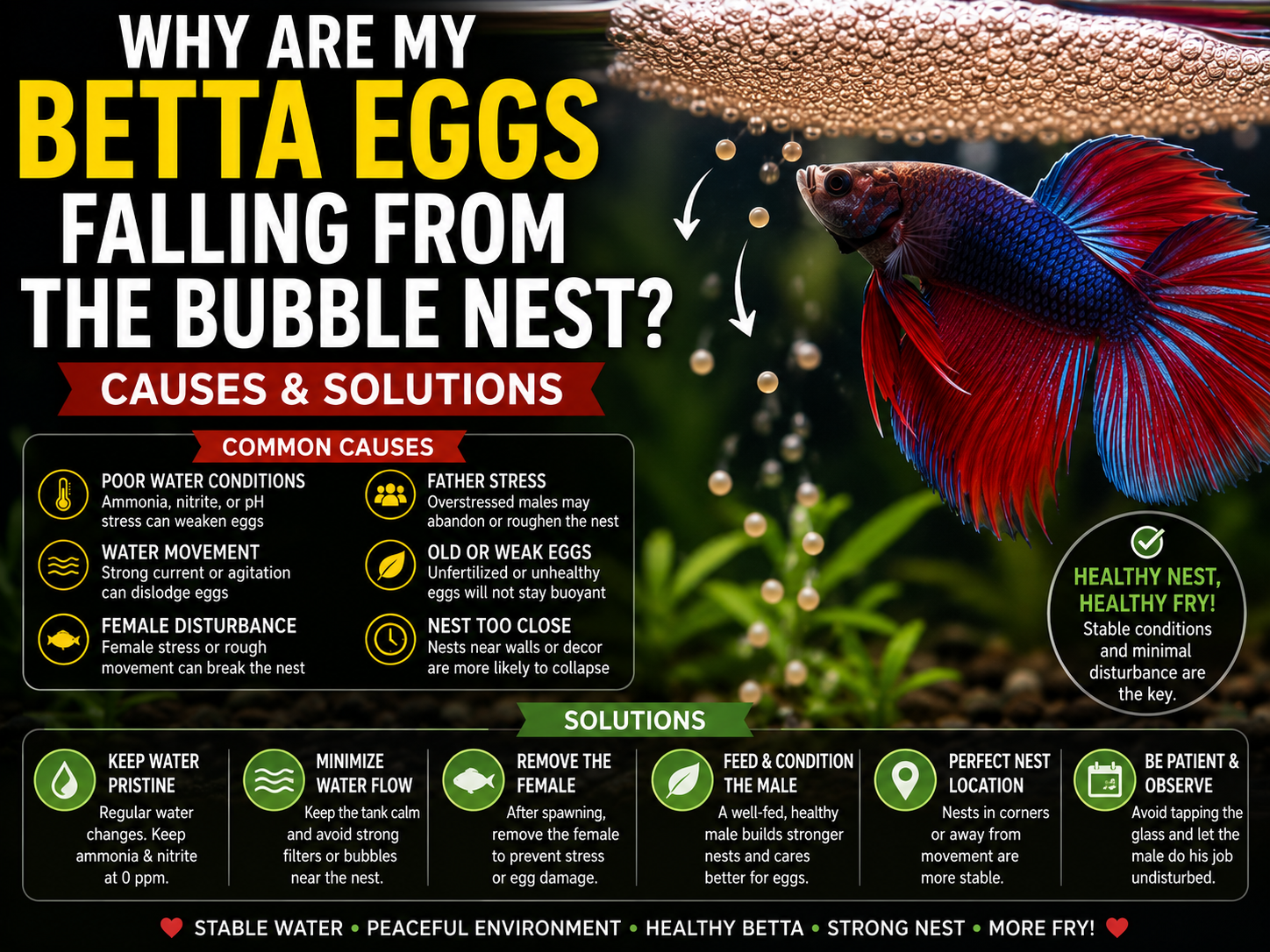
Finding your Betta fish eggs sinking to the bottom of the tank can be a stressful sight for any breeder. While it may look like a disaster, this is actually a common occurrence in the early stages of Betta spawning.
Betta eggs fall from the bubble nest primarily due to gravity, water surface agitation, or the male Betta intentionally removing infertile eggs. In most cases, the male will quickly swim down, catch the falling eggs in his mouth, and spit them back into the bubbles. If the eggs remain on the substrate, it usually indicates an inexperienced father or issues with water parameters.
Why Do Betta Eggs Fall Out of the Nest?
The primary reason Betta eggs fall is that they are denser than the water surrounding them. Unlike some fish species that have adhesive eggs that stick to plants, Betta eggs rely entirely on the structural integrity of the bubble nest.
1. The Impact of Gravity and Surface Tension
Betta eggs do not have natural buoyancy. Once the female releases them and the male fertilizes them, they begin to sink immediately. The male’s job is to coat them in mucus and tuck them into the air bubbles. If the bubbles pop or the mucus bond weakens, gravity takes over.
2. Inexperienced Male Bettas
If this is your male Betta’s first time breeding, he may be overwhelmed. Successful paternal care is a learned skill for many fish. A “newbie” father might not realize he needs to patrol the nest to catch falling eggs constantly.
3. Excessive Water Flow
Bettas are labyrinth fish that prefer stagnant or slow-moving water. If your filter creates too much surface agitation, it will physically break the bubble nest apart. This mechanical failure causes the eggs to lose their support and tumble toward the substrate.
Understanding the Role of the Male Betta
In the world of Betta splendens, the male carries the entire burden of childcare. His behavior during the 24 to 48 hours after spawning is critical to the survival of the fry.
The “Catch and Replace” Cycle
You will notice the male hovering directly under the nest. His eyes are constantly scanning for any white or translucent spheres that slip away. When an egg falls, he performs a rapid dive, retrieves it, and blows a new bubble to secure it.
Mouth Brooding vs. Bubble Nesting
While the male uses his mouth to move the eggs, he is not a mouth-brooder. He uses specialized mucus secreted from his mouth to “glue” the eggs into the nest. If he is stressed or unhealthy, he may stop producing enough of this sticky substance.
Culling Infertile Eggs
Not every egg is destined to hatch. Some eggs may not have been fertilized correctly, or they may have succumbed to fungal infections. The male can often sense which eggs are “dead weight” and will intentionally let them fall or even eat them to prevent fungus from spreading to the healthy clutch.
Technical Factors That Cause Nest Failure
To keep the eggs in the nest, the environment must be perfect. Small changes in the room’s atmosphere or the tank’s chemistry can cause the nest to disintegrate.
Humidity Levels
The bubbles in a Betta nest are made of air and saliva. If the air above the water is too dry, the bubbles will pop rapidly. Experienced breeders often use a glass lid or plastic wrap to trap humidity, which keeps the nest thick and stable.
Water Hardness and Surface Tension
Water with high mineral content or “hard water” can sometimes make it difficult for the male to form stable bubbles. According to Seriously Fish, maintaining a slightly acidic to neutral pH and soft water mimics their natural peat-swamp habitats, aiding in better nest construction.
Temperature Fluctuations
The ideal temperature for Betta breeding is between 80°F and 82°F (26.5°C to 28°C). If the water is too cold, the male becomes lethargic and may ignore falling eggs. If it is too hot, the eggs may develop too quickly, or the bubbles may burst due to increased evaporation.
How to Help a Male Betta Save the Eggs
If you see a large number of eggs on the tank floor and the male isn’t picking them up, you may need to intervene or adjust the setup.
Lower the Water Level
Many professional breeders keep the water level low, around 5 to 6 inches, during spawning. This reduces the distance the male has to swim to retrieve falling eggs. It saves his energy and increases the “catch rate” of the sinking embryos.
Provide “Anchor” Points
A bubble nest built in open water is prone to drifting and breaking. Provide floating plants, such as Amazon Frogbit or Water Lettuce. These plants give the male a physical structure to build the nest around, making it much harder for eggs to fall out.
Dim the Lighting
Bright, harsh lights can stress the male. If he feels exposed to predators, he may abandon the nest or eat the eggs out of fear. Use dim lighting or natural ambient light to help him feel secure in his paternal duties.
Common Mistakes to Avoid During the Nesting Phase
New breeders often make mistakes that inadvertently cause the eggs to fall or the male to fail.
- Leaving the Female in the Tank: Once the “nuptial embrace” is over, the Female must be removed. She will often try to eat the falling eggs, and the male will exhaust himself trying to fight her off while simultaneously catching eggs.
- Over-Cleaning the Tank: Do not perform water changes while eggs are in the nest. Even a slight siphon movement can destroy the delicate bubble structure.
- Feeding During the Guarding Phase: Most males will not eat while guarding eggs. Adding food can foul the water and distract him from his task.
When to Worry: Sinking Eggs vs. Failed Spawning
It is normal for a few eggs to fall. However, if the entire clutch is sitting on the bottom and the male is hiding in a corner, the spawn has likely failed.
Identifying Fungus on Eggs
If the eggs on the bottom start to look fuzzy or turn a dull, opaque white, they are likely infected with fungus. You can read more about aquatic fungal treatments on the University of Florida’s IFAS Extension website. Healthy eggs should be somewhat clear or creamy white without a “hairy” appearance.
The “Dead Zone” at the Bottom
In tanks with deep substrate or heavy detritus, eggs that fall may become trapped in cracks. This is why many breeders prefer “bare bottom” tanks for spawning. It allows the male to see every egg clearly so he can return it to the surface.
The Development Timeline: What Happens Next?
Understanding the timeline helps you know when the falling eggs will finally stay put.
| Stage | Timeframe | Behavior |
|---|---|---|
| Spawning | Hour 0 | Eggs are released and placed in the nest. |
| Guarding | 0 – 24 Hours | Frequent falling; the male is very active in retrieval. |
| Hatching | 24 – 48 Hours | Fry emerge with yolk sacs; they “hang” vertically. |
| Free Swimming | 72+ Hours | Fry moves horizontally; the male’s job is mostly done. |
Once the eggs hatch into “wigglers,” they will still fall out of the nest frequently. The male will continue to pick them up and spit them back into the bubbles until they are strong enough to swim on their own.
Best Practices for Nest Stability
To prevent your Betta eggs from falling unnecessarily, follow these environmental standards:
- Reduce Surface Agitation: Turn off or baffle filters to ensure the water surface is mirror-like.
- Maintain High Humidity: Keep the tank covered to ensure the air stays moist for the bubble nest.
- Minimize Stress: Keep the room quiet and avoid tapping on the glass or moving the tank.
- Optimal Depth: Keep water shallow to assist the male in his retrieval efforts.
Conclusion
Seeing your Betta eggs falling from the bubble nest is usually just a sign of the natural cycle of paternal care. In the vast majority of cases, the male is fully equipped to handle the situation. He will spend hours tirelessly retrieving his offspring to ensure they stay oxygenated at the surface.
Your job as a keeper is to provide the stable, warm, and humid environment he needs to succeed. By minimizing water flow and keeping the male stress-free, you give the eggs the best chance of developing into healthy fry.
