
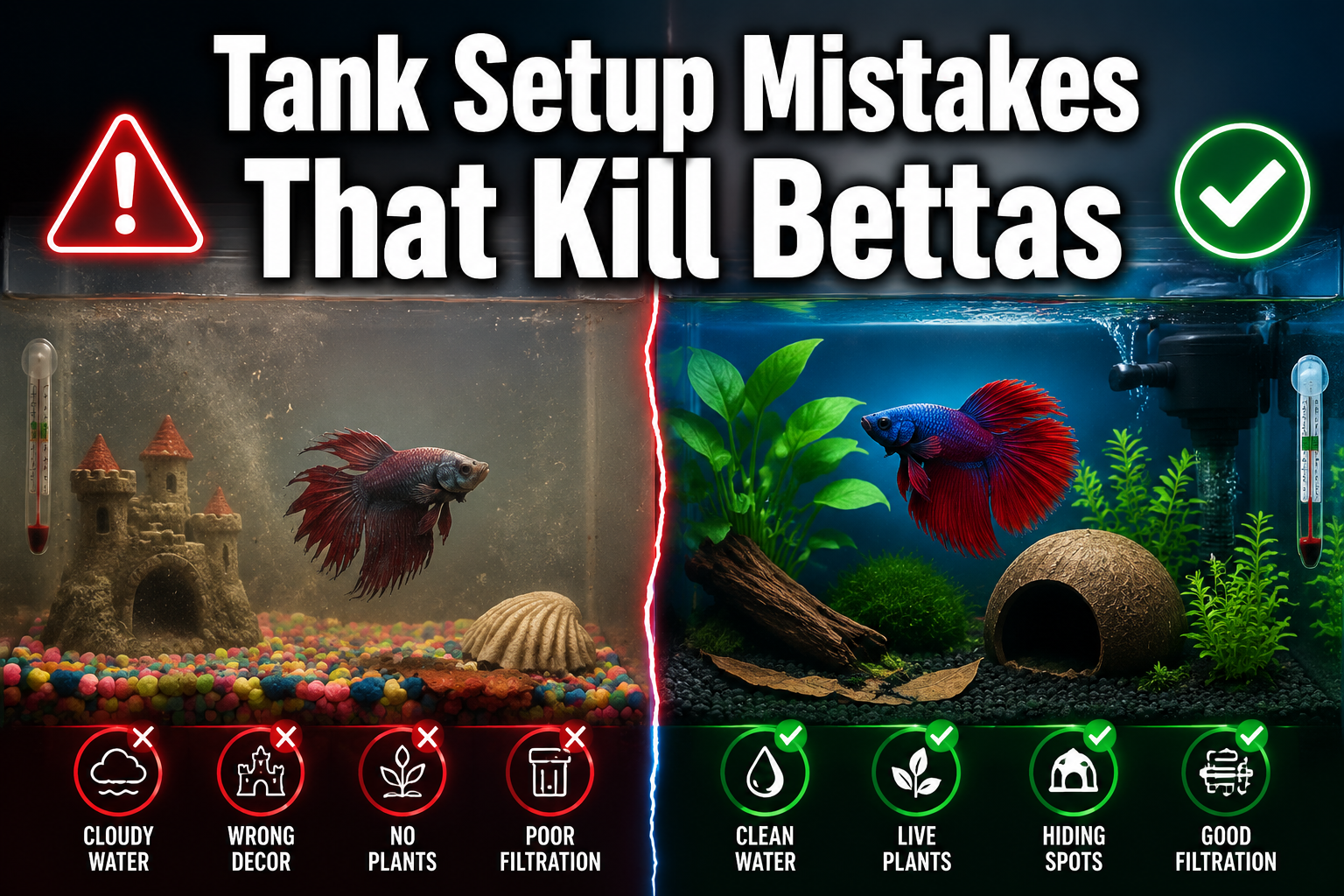
Tank setup mistakes kill more bettas than any other cause, with improper tank size, inadequate heating, and poor water conditions being the deadliest errors. Most betta deaths occur within the first month due to preventable setup failures that stress fish beyond recovery.
The most critical mistakes include using tanks smaller than 2.5 gallons, skipping heaters, and adding untreated tap water directly to new tanks.
Why Do Tank Setup Mistakes Kill Bettas So Quickly?
Bettas die rapidly from setup mistakes because they’re tropical fish with specific environmental needs that, when unmet, cause immediate physiological stress. Unlike hardy goldfish, bettas cannot adapt to poor conditions and will develop fatal illnesses within days of exposure to improper water temperature, chemistry, or tank size.
Critical stress factors that prove fatal:
- Temperature shock: Drops below 74°F shuts down betta immune systems within hours.
- Ammonia poisoning: Uncycled tanks create toxic ammonia levels that burn gills and organs.
- Space restriction: Tanks under 2.5 gallons cannot dilute waste products effectively.
- pH swings: Rapid water chemistry changes cause organ failure in sensitive bettas.
Timeline of decline: Most bettas show stress signs within 24-48 hours of poor setup conditions, develop visible illness symptoms by day 3-5, and often die within the first week if conditions aren’t corrected immediately.
What Are the Most Deadly Tank Setup Mistakes?
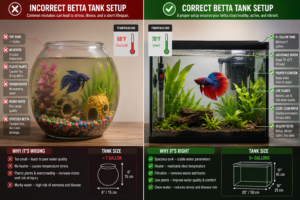
The five most lethal tank setup mistakes account for over 80% of preventable betta deaths in home aquariums. These errors create cascading health problems that quickly overwhelm a betta’s ability to survive.
1. Using Bowls or Tanks Under 2.5 Gallons
Why it kills: Small containers cannot maintain stable water parameters, leading to rapid toxin buildup and temperature fluctuations that cause organ failure.
Minimum requirements:
- 2.5 gallons absolute minimum for survival.
- 5+ gallons recommended for thriving bettas.
- Horizontal space more important than height.
2. Skipping the Heater
Fatal impact: Bettas are tropical fish requiring 76-82°F water temperature. Cold water below 74°F suppresses immune function, slows digestion, and makes bettas vulnerable to fatal infections.
Heater essentials:
- Adjustable aquarium heater rated for tank size.
- A thermometer to monitor temperature daily.
- Heater guard to prevent burns.
3. Adding Fish to Uncycled Tanks
The killer: New tanks lack beneficial bacteria to process fish waste, causing ammonia and nitrite levels that poison bettas within days.
Cycling requirements:
- 4-6 week cycling period before adding fish.
- Beneficial bacteria establishment in filter media.
- Water testing to confirm zero ammonia and nitrites.
4. Using Untreated Tap Water
Toxic effects: Chlorine and chloramines in tap water burn betta gills and destroy beneficial bacteria, creating immediate health crises.
Water treatment steps:
- Dechlorinator for every water change.
- 24-hour water aging if no dechlorinator is available.
- Temperature matching the new water to the tank water.
5. Sharp Decorations and Plastic Plants
Physical damage: Bettas have delicate fins that tear easily on sharp edges, leading to fin rot infections that can spread to the body and prove fatal.
Safe decoration choices:
- Silk or live plants only.
- Smooth ceramic or resin decorations.
- “Pantyhose test” – if decorations snag pantyhose, they’ll damage fins.
How Do Water Quality Mistakes Kill Bettas?
Water quality mistakes create toxic environments that poison bettas through their gills and skin, causing rapid organ damage and death. Poor water conditions are the leading cause of betta mortality in home tanks.
Primary water killers:
Ammonia poisoning occurs when fish waste breaks down in tanks without established beneficial bacteria. Ammonia levels above 0.25 ppm burn betta gills and cause internal organ damage within 24-48 hours.
Nitrite toxicity develops in partially cycled tanks where ammonia-processing bacteria exist, but nitrite-processing bacteria haven’t established. Nitrites prevent oxygen uptake in betta blood, causing suffocation.
pH crashes happen when organic waste accumulates and acidifies water rapidly. Bettas cannot survive pH drops below 6.0 or spikes above 8.0.
Temperature shock from unheated tanks or rapid water changes stresses bettas beyond recovery, especially when combined with other water quality issues.
Prevention protocol:
- Test water weekly for ammonia, nitrites, nitrates, and pH.
- Maintain ammonia and nitrites at 0 ppm always.
- Keep nitrates below 20 ppm through regular water changes.
- Perform 25% water changes weekly minimum.
Which Filtration Mistakes Prove Fatal?
Filtration mistakes kill bettas through either inadequate waste processing that creates toxic water conditions or excessive current that exhausts fish to death. Proper filtration balance is critical for betta survival.
Deadly filtration errors:
No filtration allows waste to accumulate rapidly in small tanks, creating ammonia spikes that poison bettas within days. Even small tanks need some form of biological filtration.
Overpowered filters create strong currents that force bettas to fight water flow constantly, leading to exhaustion, stress, and eventual death from immune system collapse.
Inadequate biological media means filters cannot establish sufficient beneficial bacteria colonies to process fish waste effectively.
Proper filtration setup:
- Gentle sponge filters are ideal for bettas.
- Adjustable flow rates on power filters.
- Biological media (ceramic rings, bio-balls) for bacterial colonization.
- Pre-filter sponges to reduce current strength.
Flow rate rule: Tank water should turn over 3-5 times per hour without creating a visible current that forces bettas to swim against the flow.
What Feeding Setup Mistakes Kill Bettas?
Feeding setup mistakes kill bettas through overfeeding that crashes water quality and underfeeding that weakens immune systems. Most new owners overfeed dramatically, creating toxic tank conditions within days.
Fatal feeding errors:
Overfeeding is the most common mistake, with excess food decomposing rapidly and spiking ammonia levels. Bettas have stomachs the size of their eyeball and need only 2-3 pellets twice daily.
Wrong food placement near filter intakes sucks uneaten food into filtration systems, where it decomposes and creates bacterial blooms.
Feeding during cycling adds unnecessary waste to tanks trying to establish bacterial colonies, prolonging the cycling process and creating toxic conditions.
Safe feeding protocol:
- 2-3 high-quality betta pellets twice daily, maximum.
- Feed in the same location away from the filter intake.
- Remove uneaten food after 5 minutes.
- Feed bettas one day per week to prevent digestive issues.
How Do Temperature Control Mistakes Kill Bettas?
Temperature control mistakes kill bettas by shutting down their immune systems and metabolic processes, making them vulnerable to fatal infections and organ failure. Bettas cannot survive temperature fluctuations that other fish tolerate.
Temperature-related deaths occur through:
Cold shock below 74°F suppresses betta immune function within hours, making them susceptible to bacterial and fungal infections that prove fatal within days.
Heat stress above 84°F accelerates metabolism beyond sustainable levels, depleting oxygen and causing organ failure.
Temperature swings of more than 2°F daily stress bettas continuously, weakening them until minor infections become fatal.
Heater failure during the winter months can drop tank temperatures 10-15°F overnight, causing immediate shock and often death.
Temperature management essentials:
- Reliable adjustable heater rated 5 watts per gallon.
- Backup heater for tanks over 10 gallons.
- Daily temperature monitoring with an accurate thermometer.
- Gradual temperature changes (1°F per hour maximum).
What Are the Warning Signs of Setup Problems?
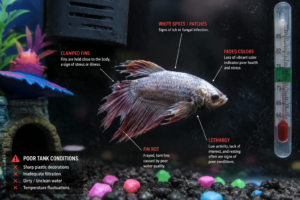
Early warning signs of tank setup mistakes appear within 24-48 hours and indicate life-threatening conditions requiring immediate correction. Recognizing these signs can save betta lives before problems become fatal.
Immediate danger signs:
- Gasping at the surface: Indicates ammonia poisoning or oxygen depletion.
- Clamped fins: Shows stress from temperature, water quality, or tank size issues.
- Lethargy: Betta staying motionless indicates serious environmental problems.
- Loss of appetite: Refusing food signals major stress or illness.
- Faded colors: Stress response to poor water conditions or inadequate setup.
Physical symptoms of setup failures:
- White spots or patches (temperature stress, poor water quality).
- Torn or rotting fins (sharp decorations, bacterial infections from poor conditions).
- Bloated appearance (overfeeding, constipation from wrong foods).
- Rapid gill movement (ammonia poisoning, oxygen depletion).
Behavioral changes indicating problems:
- Hiding constantly (inadequate territory, stress from setup issues).
- Aggressive glass surfing (tank too small, boredom from bare setup).
- Floating sideways (swim bladder problems from temperature or feeding issues).
Final Thoughts
Tank setup mistakes kill more bettas than any disease or natural cause, but every deadly error is completely preventable with proper preparation and equipment. The most critical factors for betta survival are adequate tank size (minimum 2.5 gallons), consistent heating (76-82°F), proper cycling before adding fish, and gentle filtration to maintain water quality.
Take action immediately if your betta shows warning signs like gasping, clamped fins, or lethargy by testing water parameters and correcting temperature, filtration, or tank size issues. Start with the basics: ensure your tank is large enough, properly heated, and cycled before addressing secondary concerns like decorations or feeding schedules.
FAQ
How quickly can tank setup mistakes kill bettas?
Tank setup mistakes can kill bettas within 24-72 hours. Temperature shock and ammonia poisoning are the fastest killers, often causing death within the first day of exposure to poor conditions.
What’s the absolute minimum tank size for betta survival?
2.5 gallons is the absolute minimum for betta survival, though 5+ gallons is strongly recommended. Anything smaller cannot maintain stable water parameters necessary for betta health.
Do bettas really need heaters in heated homes?
Yes, bettas need dedicated aquarium heaters even in heated homes. Room temperature (68-72°F) is too cold for bettas, who require consistent 76-82°F water temperature for proper immune function.
How long should tanks cycle before adding bettas?
Tanks should cycle 4-6 weeks before adding bettas to establish beneficial bacteria colonies. Fishless cycling with an ammonia source is the safest method to prepare tanks properly.
Can bettas survive in uncycled tanks with frequent water changes?
Bettas can temporarily survive in uncycled tanks with daily 50% water changes, but this creates constant stress and significantly increases mortality risk compared to properly cycled tanks.
What decorations are safe for betta fins?
Live plants, silk plants, and smooth ceramic or resin decorations are safe for bettas. Avoid plastic plants and sharp-edged decorations that can tear delicate betta fins.
How often should betta tank water be changed?
Betta tanks need 25% water changes weekly minimum, with smaller tanks requiring more frequent changes. Emergency 50% changes are needed if ammonia or nitrites are detected above 0 ppm.
Do bettas need filters in small tanks?
Yes, even small betta tanks benefit from gentle filtration to maintain water quality and establish beneficial bacteria. Sponge filters work well for tanks 2.5-10 gallons.
What water temperature kills bettas fastest?
Water below 70°F or above 86°F can kill bettas within hours. Sudden temperature drops are especially deadly, shutting down immune systems and causing immediate shock.
